
Views: 0 Author: Site Editor Publish Time: 2026-07-08 Origin: Site


Procuring construction materials at scale requires rigorous supplier evaluation to prevent project delays and inflated labor expenses. A single inconsistent batch of panels can derail timelines, compromise structural integrity, and create massive logistical headaches on the job site. While many suppliers market standard building panels, very few possess the strict quality control, robust logistical infrastructure, and raw material consistency necessary to fulfill large-scale commercial or residential development orders reliably.
You need a systematic, evidence-based framework for vetting suppliers. Moving beyond basic product catalogs allows you to evaluate actual manufacturing capabilities, compliance standards, and supply chain resilience. This guide provides actionable steps to assess production capacity, verify material specifications, and mitigate risks before signing a bulk purchase agreement. You will learn how to align architectural demands with factory capabilities and ensure your chosen manufacturer delivers consistent quality across every shipment.
Supplier viability hinges on verifiable production capacity and batch-to-batch consistency, not just peak product specifications.
Matching board density (low, medium, high) and dimensional specifications (thickness and panel sizes) to the specific application is critical for long-term structural integrity.
Aesthetic versatility, profile options, and thermal performance are essential evaluation metrics alongside basic durability.
Rigorous verification of ISO certifications, fire ratings, and raw material sourcing separates reliable partners from high-risk vendors.
Establishing strict technical requirements before initiating the Request for Proposal process prevents mismatched bulk orders. You must align your material specifications directly with architectural demands. Vague requests lead to inaccurate production quotes and incompatible materials arriving on site. Define your exact needs regarding density, dimensions, and application environments first. When you approach a supplier with a generic request, you invite substitutions that might not meet local building codes or specific structural engineering requirements.
Contractors often face issues when procurement teams order materials based solely on square footage without considering the specific structural loads the panels will endure. You must document the exact wind load requirements, fire separation distances, and acoustic ratings required by the architect. This documentation forms the baseline for your supplier evaluation. If a manufacturer cannot meet these documented criteria with standard production runs, they are not a viable partner for your project.
Density dictates how a panel performs under stress. You must map density grades to specific structural and environmental thresholds. High-density panels withstand high wind loads and severe weather, making them ideal for exterior facades. Medium-density options serve standard interior applications, while low-density boards offer lighter weight for less demanding environments.
Density Grade | Typical Application | Key Performance Characteristic | Installation Considerations |
|---|---|---|---|
High-Density (Above 1.3 g/cm³) | Exterior facades, high-impact zones, commercial cladding | Maximum tensile strength, severe weather resistance | Requires specialized diamond-tipped blades; heavier to lift |
Medium-Density (1.0 - 1.3 g/cm³) | Standard interior walls, soffits, tile backer boards | Balanced durability and workability | Standard carbide tools acceptable; manageable by two-person crews |
Low-Density (Below 1.0 g/cm³) | Ceilings, low-impact decorative areas | Lightweight, easier handling | Prone to edge damage if mishandled; fast installation |
Dimensional standardization heavily influences project efficiency. Standard sheet sizes usually range from 4'x8' to 4'x10', with thickness spanning 6mm to 20mm. Procuring non-standard dimensions complicates logistics. Custom sizes increase lead times, complicate waste factor calculations, and demand specialized installation labor. Stick to standard dimensions whenever architectural plans allow to streamline procurement and installation. When you order 5/16-inch panels for a job that actually requires 1/2-inch structural sheathing, the resulting deflection under load will cause joint failure and water intrusion.
Exterior and interior applications require fundamentally different performance baselines. You cannot use the same evaluation criteria for both environments. When evaluating cement board manufacturers for partition systems, prioritize acoustic attenuation, impact resistance, and seamless integration with steel framing. These interior panels must support localized load-bearing capacity for fixtures while maintaining high STC ratings for soundproofing between commercial units or residential apartments.
Conversely, exterior cladding demands extreme weather resilience. Evaluate exterior boards based on freeze-thaw resistance, UV exposure tolerance, and moisture barrier integration. Thermal performance also plays a role. Assess the panel's contribution to overall R-values and energy efficiency benefits. The manufacturer must prove their exterior products can withstand decades of environmental abuse without delaminating or degrading. Ask for accelerated weathering test results to verify these claims.
Architectural styles dictate specific aesthetic requirements. Evaluate the manufacturer's capability to supply diverse profiles. You may need lap, panel, channel-siding, or shingle profiles to match the design vision. A versatile supplier can adapt their production lines to meet these varied aesthetic demands without sacrificing structural integrity. Consistency in the depth of wood-grain embossing or the smoothness of modern flat panels is a strong indicator of manufacturing quality.
Consider the tradeoffs between standard primed panels and factory pre-finished panels. Buying standard primed panels requires on-site finishing, which adds labor time but offers ultimate color flexibility. Factory pre-finished panels provide superior coating consistency and immediate weather protection. However, pre-finished panels require strict handling protocols to prevent surface damage during transit and installation. Scratched pre-finished panels require touch-ups that rarely match the factory bake, leading to punch-list disputes with the owner.
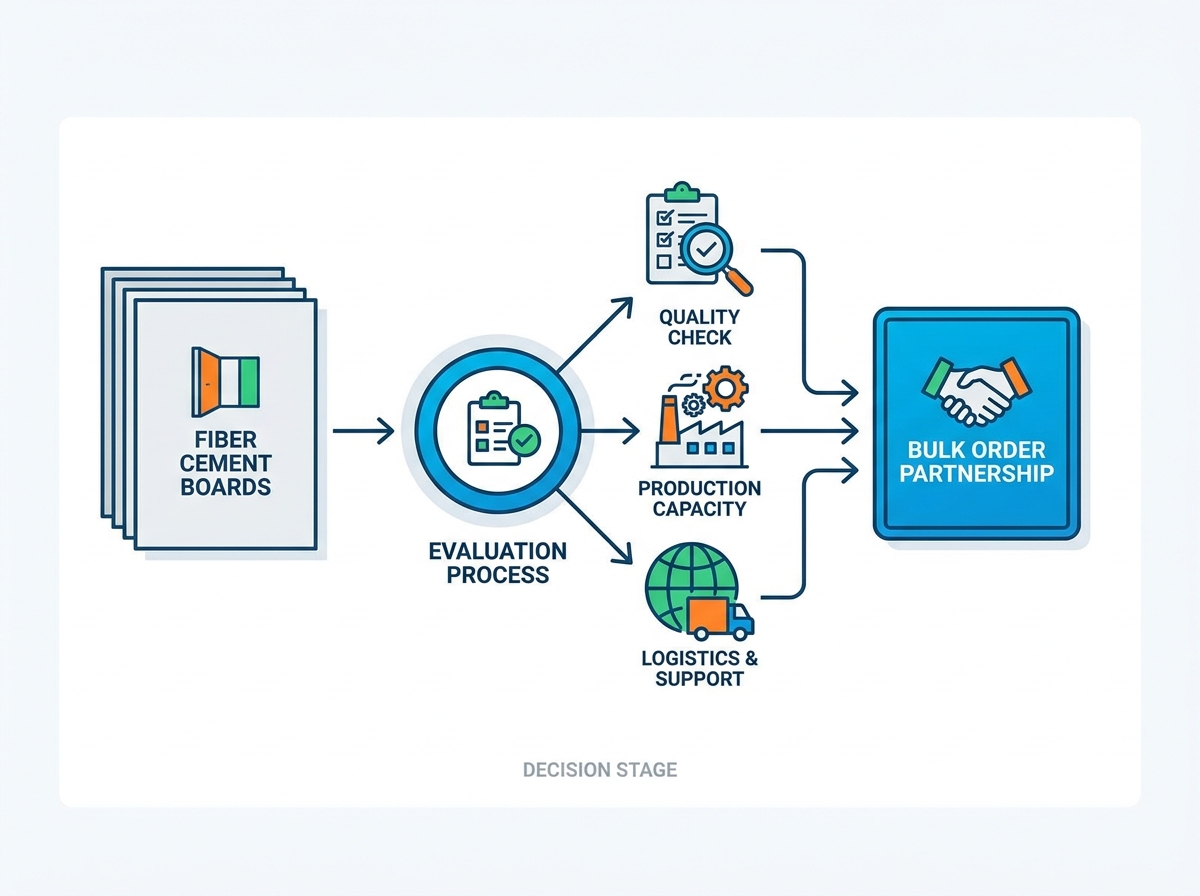
A manufacturer's facility infrastructure directly impacts their ability to fulfill bulk orders. Scale matters. You need a partner whose production lines can handle massive volume without compromising panel integrity. A thorough audit of their manufacturing capabilities separates genuine industrial suppliers from mere distributors who simply rebrand imported materials.
The core strength of any panel relies on its chemical mixture. The standard composition includes cellulose fiber, silica, and Portland cement. The precise ratios of these ingredients determine the board's flexibility and strength. Ask suppliers about their specific mixture formulas and how they adjust ratios for different density grades. A higher cellulose content increases flexibility but can compromise moisture resistance if not properly sealed and cured.
Variations in raw material purity significantly affect the final product. Sourcing locations and filler percentages alter tensile strength and long-term durability. High-quality silica and premium Portland cement ensure a stable, reactive mixture. Inferior raw materials lead to brittle boards prone to cracking under structural stress or temperature fluctuations. Request documentation on their raw material supply chain to ensure they aren't using low-grade fly ash substitutes that degrade over time.
High-pressure steam curing, known as autoclaving, is a technical necessity. This process accelerates cement hydration and silica reactivity. It transforms raw materials into dimensionally stable, highly durable panels. Without proper autoclaving, the boards remain susceptible to moisture expansion and shrinkage, which causes fastener pull-through and joint cracking on the building exterior.
Verify the standard autoclaving temperature ranges used for the specific density you are ordering.
Review the manufacturer's procedures for monitoring and controlling pressure during the curing cycle.
Confirm the exact curing time allocated for high-density panels to ensure complete chemical bonding.
Request historical logs of their batch-testing protocols to prove consistency across multiple production runs.
Procurement teams must ask these specific audit questions. Consistent autoclave management guarantees every fiber cement board meets structural specifications. If a supplier hesitates to provide autoclave data, consider it a major red flag regarding their quality control.
Never take quoted lead times at face value. Establish a framework for auditing actual daily and monthly production capacity. Compare their stated capacity against historical delivery performance. Request references from previous bulk buyers to verify their on-time delivery rates. A supplier claiming they can produce 100,000 square feet a week means nothing if their shipping department can only load three flatbeds a day.
Identify warning signs in production schedules. Reliance on a single autoclave line presents a massive bottleneck risk. If that machine goes down for maintenance, your project stops. A lack of raw material stockpiles indicates vulnerability to supply chain shocks. These red flags signal a high risk of delayed shipments, which can paralyze your construction timeline and incur massive liquidated damages from the project owner.
Marketing claims hold no weight without third-party verified testing documentation. Proprietary, in-house laboratory data is insufficient for large-scale construction projects. Demand independent certification to ensure the materials meet local building codes and safety regulations. Building inspectors will reject materials that lack proper stamps and testing reports, forcing you to tear down completed work.
Fire safety is non-negotiable. A viable manufacturer must pass strict combustibility testing. Request documentation proving compliance with industry-standard protocols for non-combustibility and flame spread, such as ASTM E136 and ASTM E84 Class A. These certifications confirm the panels will not contribute to fire propagation. For multi-family residential projects, you must also verify the 1-hour and 2-hour fire-rated assembly details provided by the manufacturer.
Moisture performance requires equal scrutiny. Panels used in wet areas or high-humidity environments must undergo rigorous testing. Detail the specific moisture penetration, absorption, and water-resistance tests the manufacturer conducts. Boards must demonstrate minimal swelling and zero delamination after prolonged water exposure. Ask for the results of the ASTM C1186 testing, which specifically measures the physical properties of these panels under wet conditions.
Certifications indicate supplier maturity and operational discipline. ISO 9001 certification ensures a robust Quality Management System is in place. ISO 14001 certification demonstrates a commitment to Environmental Management. These standards prove the supplier operates with consistent, documented procedures rather than ad-hoc manufacturing methods.
Address silica safety and sustainability directly. Discuss compliance regarding crystalline silica dust exposure limits during the manufacturing process. Furthermore, evaluate the supplier's commitment to eco-friendly production practices. Look for recycled content certifications and waste-water recycling systems within their facilities. Suppliers with strong environmental controls are generally more stable and less likely to face sudden regulatory shutdowns.
Logistical inefficiencies and transport damage quickly erode procurement budgets. Shipping heavy, rigid materials in bulk presents significant physical challenges. You must analyze the entire supply chain to calculate the true impact of material acquisition accurately. A cheap panel becomes expensive if 20% of the load arrives with broken corners.
Heavy cargo logistics require specialized handling. The sheer weight of bulk panel orders demands robust transport solutions. Evaluate the manufacturer's packaging standards meticulously. Poor packaging guarantees transit damage, resulting in unusable materials arriving at your site. You need to know exactly how the material will be loaded onto the flatbeds and what equipment your site needs to unload it safely.
Scrutinize their palletizing methods, strapping tension, and edge-protection protocols. Proper dunnage prevents panels from shifting during transit. Edge protectors stop strapping from biting into the boards. Insist on shrink-wrapping to protect against moisture during open-bed transport. If the manufacturer uses flimsy pallets that break under the weight of a telehandler, your crews will waste hours manually restacking dropped loads.
Deconstruct typical warranties to identify common exclusions. Many warranties void coverage for improper handling, specific fastener requirements, or atmospheric exposure limits prior to installation. Read the fine print to understand exactly what the manufacturer guarantees and what liabilities fall on your installation team. If a warranty requires a specific proprietary weather barrier that you didn't budget for, your costs will skyrocket.
Compare the warranty longevity of factory pre-finished panels against standard primed boards. Pre-finished warranties often include coating adhesion guarantees and specific maintenance expectations. Ensure these maintenance requirements align with the building owner's long-term facility management capabilities. A 15-year paint warranty is useless if it requires annual chemical washing that the owner will never perform.
Bulk procurement often conceals ancillary expenses. Identify easily overlooked materials required for proper installation. The manufacturer may require specialized cutting tools to manage silica dust safely. You might also need specific joint compounds, proprietary fasteners, or mandatory flashing and trim systems to maintain warranty validity. Account for these necessary accessories during the initial procurement phase to avoid budget overruns during the framing and exterior finishing stages.
Anticipating project roadblocks protects your timeline and budget. Supplier-side failures happen, but proactive planning minimizes their impact. Implement actionable strategies to manage disruptions and ensure continuous material flow to the job site. You cannot afford to have a framing crew standing around waiting for a delayed truck.
Structure purchase agreements with strict contractual protections. Include penalty clauses for late deliveries to incentivize on-time performance. Define acceptable dimensional tolerances for thickness and panel sizes in the contract. If a batch falls outside these tolerances, the penalty clauses activate. This forces the manufacturer to prioritize your order and maintain strict quality control.
Establish a clear defect protocol. If your team discovers defective materials during installation, you need a rapid replacement process. Negotiate shipping timeline guarantees for replacement batches to prevent work stoppages. The supplier must commit to expedited freight for any material failures. Document the exact process for submitting a claim, including required photographic evidence and batch numbers.
Evaluate the depth of the manufacturer's technical product literature. Comprehensive detailing guides and installation manuals are essential for complex commercial projects. Clear documentation prevents installation errors that could void warranties or compromise structural integrity. If the manufacturer only provides a two-page generic PDF, they lack the technical depth required for commercial construction.
Determine the availability of on-site manufacturer technical representatives. For massive developments, having a factory rep on-site ensures installers follow best practices. Ask if the supplier offers certification programs for your installation crews. Trained crews work faster, make fewer mistakes, and ensure full warranty compliance. A pre-construction meeting with the manufacturer's technical team can solve flashing and integration issues before they happen on the wall.
Initiate the RFQ process using highly detailed architectural specifications and documented structural load requirements.
Request physical samples from different production batches to verify consistency in density, thickness, and surface finish.
Demand comprehensive independent testing documentation for fire ratings and moisture resistance from all shortlisted vendors.
Draft purchase agreements that include strict penalty clauses for late deliveries and out-of-tolerance defective batches.
Schedule a pre-construction technical review with the manufacturer's representatives to finalize installation and warranty requirements.
A: Standard lead times typically range from 4 to 8 weeks, depending on the manufacturer's current capacity and autoclave availability. Custom profiles or non-standard dimensions can extend this timeline significantly. Always verify actual production schedules before finalizing an order.
A: Request documentation on their sourcing locations and ask for batch-testing reports. High-quality manufacturers will readily provide data on silica purity, Portland cement grades, and cellulose fiber quality used in their mixture formulas.
A: Yes. Some manufacturers specialize in interior partition systems focusing on acoustic ratings and lightweight workability. Others focus entirely on exterior cladding, prioritizing freeze-thaw resistance, UV stability, and high wind-load tolerances.
A: Common exclusions include damage from improper on-site storage, failure to use proprietary fasteners, incorrect structural framing, and lack of required ongoing maintenance. Always read the specific handling and installation requirements.
A: The high-pressure steam curing in an autoclave accelerates the chemical reaction between silica and cement. This process locks the materials together, drastically improving dimensional stability, moisture resistance, and overall tensile strength.
A: Acceptable thickness tolerances generally fall within ±0.5mm to ±1.0mm, depending on the overall board thickness. Strict tolerances ensure flush joints and smooth surface finishes during installation.


