
Views: 0 Author: Site Editor Publish Time: 2026-07-31 Origin: Site


Material degradation in high-stress, moisture-prone, or impact-heavy environments remains a primary driver of contractor callbacks, warranty claims, and margin erosion. When building materials fail under environmental pressure, the resulting repairs consume time and destroy project profitability. Contractors and specifiers must balance stringent building codes regarding fire and moisture resistance with installation efficiency and long-term durability. Traditional drywall or standard cement boards often prove inadequate for these demanding applications. To solve these structural, environmental, and aesthetic challenges, professionals turn to engineered alternatives. A fiber cement board serves as a high-performance substrate designed for modern construction. Its specific material properties offer reliable solutions for areas where standard materials degrade, warp, or fail entirely under stress.
Unmatched Durability in Harsh Zones: Fiber cement board provides superior impact resistance and dimensional stability in high-traffic and wet environments compared to standard gypsum.
Code Compliance and Safety: Offers Class A fire ratings and does not contribute to toxic smoke, making it critical for commercial and institutional assemblies.
Distinct Material Advantages: Outperforms calcium silicate in bending strength and traditional cement board in flexibility, though it requires specific handling protocols.
Lifecycle ROI: The higher initial material and labor costs are offset by near-zero callback rates, lower maintenance, and extended assembly lifespans compared to natural wood or gypsum.
The strength of these panels comes from a highly controlled manufacturing process and a precise blend of raw materials. Manufacturers combine Portland cement, silica sand, wood or cellulose fibers, and water to create a dense, resilient core. The Portland cement acts as the primary binder, providing the raw compressive strength required for heavy-duty applications. Silica sand acts as an aggregate, adding density and fire resistance to the panel. The cellulose fibers serve as internal reinforcement, preventing the cement mixture from becoming overly brittle and giving the board its necessary tensile strength. Water activates the cementitious reaction, binding the components together into a solid matrix.
During manufacturing, the boards undergo an autoclave curing process. High-pressure steam cures the cement matrix rapidly, accelerating the chemical hydration of the cement and silica. This curing method creates a dimensionally stable panel that strongly resists warping, rotting, and delamination. Even under severe temperature fluctuations or prolonged exposure to humidity, the material maintains its structural integrity. The autoclave process also ensures that the boards leave the factory fully cured, meaning they will not shrink or expand significantly once installed on the job site.
Component | Primary Function in the Matrix | Field Benefit |
|---|---|---|
Portland Cement | Primary binder and structural core | Provides high compressive strength and moisture resistance. |
Silica Sand | Aggregate and density modifier | Enhances fire resistance and overall panel hardness. |
Cellulose Fibers | Internal tensile reinforcement | Prevents brittleness, allows for slight flexibility during handling. |
Water | Chemical activator | Facilitates the hydration process for a solid, uniform cure. |
Commercial-grade assemblies require materials that meet strict performance baselines. Walls must provide sufficient load-bearing capacity to support heavy finishes like large-format ceramic tile, natural stone, or heavy commercial fixtures. They must also deflect moisture effectively, preventing water vapor from penetrating the wall cavity and compromising the structural framing or insulation. Furthermore, these assemblies must maintain acoustic and fire separation between different building zones, adhering to strict life-safety codes.
Fiber cement panels align with these criteria significantly better than legacy materials. They provide the necessary shear strength to hold heavy veneers without sagging or tearing away from the fasteners. Their dense composition contributes to effective fire-rated separations, ensuring compliance with strict commercial building codes. When properly installed with the correct framing and fasteners, these panels create a rigid, unyielding substrate that prevents the cracking of grout lines and the failure of applied finishes.
Moisture handling represents the most significant difference between these materials. Standard and moisture-resistant gypsum boards (often referred to as green board) rely on a gypsum core wrapped in paper or fiberglass. When exposed to continuous moisture or bulk water, the gypsum core absorbs water, swells, sags, and eventually disintegrates. The paper facing also provides a food source for mold. Conversely, fiber cement maintains its structural integrity even when completely saturated. It will not disintegrate, swell, or feed mold growth, making it the superior choice for wet areas.
Gypsum remains lighter, easier to score and snap, and offers baseline sound attenuation, making it suitable for standard interior partitions where moisture and impact are not concerns. However, fiber cement board wall ceiling assemblies deliver superior impact resistance. This makes them ideal for high-traffic corridors in hospitals, schools, and transit hubs, where gurneys, carts, and heavy foot traffic frequently damage standard drywall.
Traditional cement boards typically consist of a cement core reinforced with fiberglass mesh on both faces. While highly water-resistant, they are often heavy, rigid, and difficult to handle on-site. Cutting them requires specialized carbide-tipped scoring tools or diamond blades, and the process can result in jagged edges, crumbling cores, and significant material waste if not handled carefully. The fiberglass mesh can also irritate workers' skin during installation.
The inclusion of cellulose fibers in modern fiber cement provides higher tensile strength and greater flexibility compared to the rigid, brittle nature of traditional glass-mesh cement boards. These panels offer smoother surfaces, making them easier to finish or use as an exposed architectural element. The flexibility reduces the risk of snapping during transport, carrying, and installation, especially when maneuvering large sheets through tight commercial job sites.
Mechanical stress tolerances differ between these two engineered boards. Fiber cement generally offers higher bending strength and structural resilience due to its specific fiber-to-cement ratio and autoclave curing. This makes it highly suitable for areas subjected to mechanical stress, heavy impact, and applications requiring high pull-out strength for fasteners.
Calcium silicate is often lighter and provides excellent passive fire protection, often used for encasing structural steel. Specifiers choose between the two based on project requirements. Calcium silicate works well for weight-restricted fireproofing and high-temperature industrial applications, while fiber cement excels in localized impact zones, heavy-duty substrate applications, and exterior cladding where weather resistance is paramount.
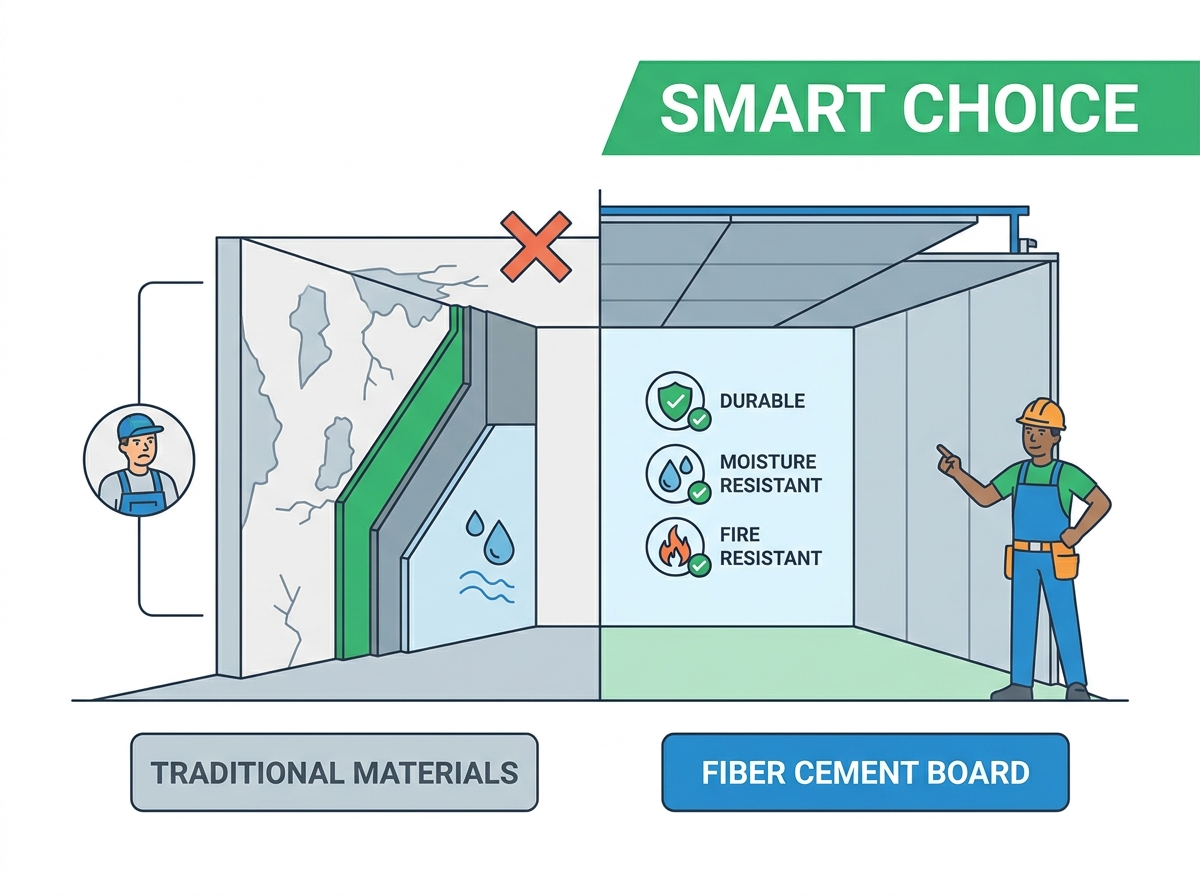
Commercial kitchens, public restrooms, locker rooms, and natatoriums demand materials that withstand constant humidity, frequent washdowns, and direct water exposure. Fiber cement panels excel in these environments. They do not degrade when exposed to steam or direct water contact, providing a reliable barrier that protects the underlying framing from moisture damage.
Furthermore, these boards serve as an optimal substrate for heavy tile and stone veneers. Their dimensional stability ensures that the substrate does not expand or contract significantly with changes in humidity. This stability is critical for preventing grout lines from cracking and tiles from popping off the wall. Contractors rely on them to create durable, waterproof assemblies in critical wet areas, often pairing them with fluid-applied waterproofing membranes for complete system protection.
Contractors frequently specify a fiber cement board wall ceiling system for transitional spaces. Exterior ceilings, breezeways, parking garage soffits, commercial patios, and deck undersides face wind loads, high humidity, and extreme temperature swings. Standard drywall, even exterior-grade gypsum sheathing, fails rapidly in these conditions due to moisture absorption and wind-driven deflection.
Fiber cement resists moisture absorption and wind deflection, providing a stable, rigid surface for exterior ceilings. It accepts exterior-grade paints and finishes readily, ensuring long-term aesthetic appeal without the constant maintenance, scraping, and repainting required by natural wood or the eventual sagging seen with exterior gypsum products.
Beyond acting as a hidden substrate for tile or plaster, fiber cement serves as a durable, low-maintenance alternative to natural wood. Designers utilize it for modern board-and-batten style interior accent walls, heavy-wear vertical cladding in lobbies, and exterior facades.
It mimics the aesthetic of wood through various factory-applied textures, but it eliminates the associated risks of rotting, warping, splitting, or termite damage. This makes it an excellent choice for high-end commercial spaces that require both visual appeal and extreme durability, reducing the long-term maintenance burden on facility managers.
Life safety compliance dictates material selection in commercial construction. Fiber cement panels achieve non-combustibility ratings under standards like ASTM E136. They do not ignite, spread flame, or contribute fuel to a fire, nor do they release toxic smoke when exposed to high temperatures.
Engineers integrate these panels into 1-hour and 2-hour fire-rated wall systems. Their ability to withstand high temperatures without structural collapse makes them a vital component in protecting escape routes, stairwells, and separating hazardous areas within commercial and industrial facilities.
The initial procurement cost of fiber cement is higher per square foot than standard gypsum drywall. However, this upfront material premium is offset by the elimination of water damage remediation, impact repairs, and paint failures over the life of the building. In high-traffic or wet environments, drywall requires frequent patching, repainting, or complete replacement. Fiber cement installs once and withstands the abuse, drastically reducing maintenance budgets and eliminating the disruption of ongoing repairs.
The heavier weight per sheet compared to drywall impacts crew fatigue and installation speed. A standard half-inch sheet of fiber cement requires two workers to lift and position safely, especially for ceiling applications. This added weight necessitates careful logistical planning on the job site to stage materials close to the installation area.
Additionally, cutting fiber cement requires specialized tooling. Standard utility knives cannot score and snap the material effectively. Contractors must invest in polycrystalline diamond (PCD) blades for circular saws or specialized electric shears to manage wear and tear on equipment and ensure clean, accurate cuts without burning out standard steel blades.
The primary installation risk involves respirable crystalline silica. Cutting fiber cement with high-speed saws generates fine silica dust that poses severe respiratory hazards. OSHA compliance requires strict dust management protocols on every job site to protect workers from silicosis and other lung diseases.
Contractors must implement mandatory mitigation strategies. These include:
Using HEPA vacuums directly attached to circular saws and routers to capture dust at the source.
Employing wet cutting techniques where water is applied to the blade during the cut to suppress dust.
Utilizing specialized electric shears or score-and-snap tools for straight cuts, which generate heavy chips rather than fine airborne dust.
Ensuring all workers in the vicinity wear proper personal protective equipment (PPE), including N95 or P100 respirators.
Because fiber cement is heavy, it requires robust structural support. Framing must meet specific gauge requirements to support the dead load of the panels and any applied finishes. For steel framing, a minimum of 20-gauge structural studs is typically required. Standard wood framing is acceptable, but stud spacing must often be reduced to 16 inches on center, or even 12 inches on center for heavy tile applications or ceiling installations.
Installation also demands specific accessories. Contractors must use alkali-resistant fiberglass mesh tape for joints, as standard paper tape will degrade in the alkaline environment of the cement. Fastening requires specific corrosion-resistant, alkali-resistant, ribbed-head screws. These screws are designed with cutting nibs under the head to self-countersink into the dense material without mushrooming the surface or snapping the screw head.
Setting realistic expectations for finishing is crucial. Fiber cement is typically used as a substrate or specialized cladding rather than a Level 5 finished painted surface. Achieving a completely smooth, seamless finish across joints is difficult compared to standard gypsum drywall due to the density of the board and its slight thermal expansion properties.
Proper joint treatment prevents telegraphing or cracking. Installers must leave a slight gap between panels, fill the gap with a compatible setting-type compound or elastomeric sealant, and embed alkali-resistant tape. When painted directly, the surface often retains a slight texture. Therefore, it is frequently preferred as a tile substrate, covered with a textured wallcovering, or used as an expressed-joint cladding system where the joints become an architectural feature.
Fiber cement board is not a universal replacement for drywall. It is a specialized, high-performance solution designed for environments where environmental or physical failure is not an option. By understanding its strengths, handling requirements, and structural demands, contractors can eliminate callbacks and ensure long-lasting assemblies in the most demanding commercial applications.
Take the following actionable steps for your next project:
Review the architectural plans to identify high-moisture zones, heavy-traffic corridors, and exterior soffits where standard drywall will likely fail.
Equip your installation crews with OSHA-compliant dust extraction tools, HEPA vacuums, and specialized cutting shears before materials arrive on site.
Verify that the structural framing gauge and stud spacing meet the manufacturer's requirements to support the added dead load of the panels and any heavy veneers.
Contact a manufacturer representative to download technical data sheets and review local building code approvals for project-specific load calculations.
A: It is highly water-resistant and will not disintegrate when wet. However, it still requires a topical waterproofing membrane in continuous-wet areas like commercial showers to prevent moisture from passing through the panel and into the wall cavity.
A: Yes, it is commonly used in ceilings, such as soffits and transitional outdoor spaces like patios. It requires proper framing spacing, usually 16 inches on center maximum, and robust structural support due to its heavier weight compared to drywall.
A: Fiber cement mimics the aesthetic of natural wood, such as in board-and-batten configurations, but completely eliminates issues like rotting, warping, termite damage, and the need for frequent scraping and repainting.
A: To minimize silica dust and comply with OSHA regulations, use fiber cement shears or circular saws equipped with specialized polycrystalline diamond blades and dust-collecting HEPA vacuums.
A: Its mass contributes to Sound Transmission Class (STC) ratings. However, for true soundproofing, it must be part of a designed acoustic assembly that includes cavity insulation and resilient channels.
A: You must use corrosion-resistant, alkali-resistant, ribbed-head screws. These are specifically designed to self-countersink into the dense material without causing the surface to mushroom or the screw to snap.
A: Yes, using proper alkaline-resistant primers. However, it is difficult to achieve a smooth, seamless Level 5 finish compared to gypsum drywall, making it better suited for textured finishes or as a tile substrate.


