
Views: 0 Author: Site Editor Publish Time: 2026-07-29 Origin: Site


Material degradation prior to installation is a leading cause of preventable financial loss and schedule overruns on exterior cladding and tile-backing projects. While fiber cement board is engineered for extreme durability post-installation, it is highly susceptible to moisture saturation, deflection, and micro-fracturing during transit, unloading, and job site staging. Establishing strict, standardized protocols for receiving, storing, and moving these heavy panels is mandatory. Proper site management preserves material integrity, ensures OSHA compliance, and protects manufacturer warranties. Site managers must treat these panels as vulnerable finished goods before they go on the wall. By understanding the physical properties of these boards, crews can eliminate the hidden costs associated with improper handling. This guide covers the exact steps required to safely manage these products from the moment they arrive on site until they are securely fastened to the structure.
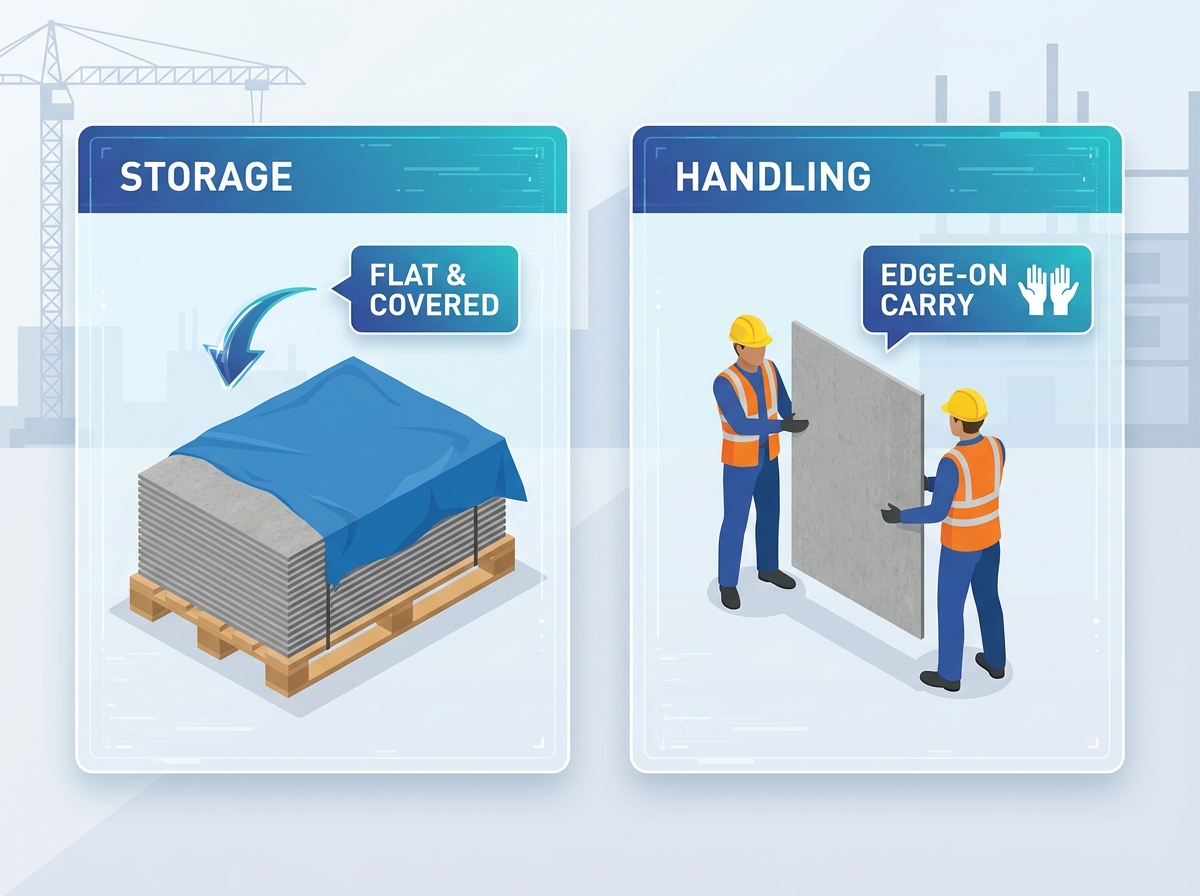
Moisture Management is Mandatory: Panels must be stored flat, off the ground, and protected by waterproof covers that still allow for cross-ventilation to prevent condensation.
Handling Requires Specific Geometry: Boards must always be carried on their edge (vertically) by two workers to prevent bowing, snapping, and internal structural damage.
Pre-Installation Acclimation: Saturated or improperly stored boards will experience dimensional instability (shrinkage) post-installation, leading to joint failures and voided warranties.
Site Prep Dictates Success: Evaluating staging areas for ground clearance, grade restrictions, and equipment access before delivery mitigates 90% of handling risks.
Defining the cost of material failure versus the minimal operational cost of proper site management is the first step in protecting your project budget. These panels represent a significant material investment for any commercial or residential build. When site crews neglect basic storage protocols, the resulting damage often exceeds the cost of the materials themselves. You have to factor in labor for tear-outs, replacement delays, and compromised structural integrity. A few pallets of ruined material can easily derail a tight construction schedule.
Unventilated tarping, standing water, or direct exposure to rain and snow causes panels to absorb moisture rapidly. When the material absorbs excess water, it expands. If installed while saturated, the boards will inevitably shrink as they dry out on the wall. This post-installation shrinkage leads to gapping at the seams, cracked caulking, and potential moisture intrusion into the building envelope. We often see contractors forced to rip down entire elevations because they fastened wet boards that later shrank and exposed the weather-resistant barrier.
The physics of panel deflection dictate how these materials must be moved. Carrying boards flat creates invisible stress fractures across the panel surface. These micro-fractures compromise the fastener holding power, making the boards susceptible to wind blow-off or cracking under thermal expansion. The damage is often unseen until the panel fails post-installation. When a worker carries a twelve-foot plank flat, the center sags under its own weight, snapping the internal fibers even if the board does not break completely in half.
Unsecured loads during the final miles of transport lead to edge crumbling and structural hairline cracks before the material even arrives on site. Road vibrations transfer directly into the rigid panels. Ensuring that pallets are tightly banded and properly supported during transit prevents the edges from grinding against each other. This grinding ruins the factory finish and structural edges. Delivery drivers must navigate uneven job site entrances carefully to avoid shocking the load.
Standard warranty clauses explicitly exclude damage caused by improper job site storage and handling. Manufacturers require proof that materials were kept dry, stored flat, and handled correctly. Failing to adhere to these basic guidelines instantly voids any claim for material defects. This leaves the contractor fully liable for replacements. If a manufacturer representative visits a site and sees pallets sitting in mud, they will document the violation and deny future claims related to shrinkage or delamination.
Storage Condition | Physical Impact on Board | Post-Installation Consequence |
|---|---|---|
Direct Ground Contact | Capillary action draws moisture into panel edges | Edge swelling, paint peeling, delamination |
Tightly Wrapped in Plastic | Greenhouse effect traps condensation | Surface efflorescence, adhesive bond failure |
Uneven Dunnage Support | Pallet sagging and permanent panel deflection | Wavy wall appearance, snapped boards during lifting |
Exposed to Rain/Snow | Full panel saturation and expansion | Severe joint gapping as boards shrink on the wall |
Establishing the logistical framework before the freight arrives ensures a smooth, damage-free unloading process. Site preparation is often overlooked, leading to chaotic deliveries where heavy pallets are dropped in unsuitable locations simply because the equipment cannot reach the ideal staging area. You must control the delivery environment.
Planning for the extreme weight of bulk deliveries is essential. Ensure delivery vehicles have clear access routes that can support heavy-axle loads without sinking into mud or tipping on uneven terrain. A fully loaded pallet can weigh several thousand pounds, requiring stable, compacted ground for safe transport and unloading. Soft dirt or fresh gravel will cause forklifts to get stuck, forcing crews to manually offload panels, which drastically increases the risk of damage and injury.
Choose a flat, level, and well-drained location away from heavy site traffic, overhead hazards, and areas prone to standing water or snow accumulation. The staging area should be close enough to the installation zone to minimize carrying distance but far enough away to avoid damage from other construction activities. Avoid placing pallets near scaffolding erection zones or heavy machinery paths where they might be struck.
Identify a staging zone with a maximum slope of 2 percent to prevent pallet sliding.
Verify the ground bearing capacity can handle at least 3,000 pounds per pallet footprint.
Clear the area of large rocks, debris, and construction waste that could interfere with forklift tires.
Establish a clear travel path from the staging area to the cutting station.
Ensure the staging area has adequate drainage to prevent water pooling during heavy rain.
Assess the need for forklifts with wide-spread forks to prevent pallet overhang deflection. Boom trucks and heavy-duty pallet jacks are often required to safely transfer heavy pallets without edge damage. Using undersized equipment causes the pallets to bow, which immediately transfers stress to the bottom boards, causing them to snap. Fork extensions are highly recommended when lifting pallets longer than eight feet.
Continuous, level support is required to prevent pallet sagging over uneven terrain. Place dunnage at maximum 16-inch intervals beneath the pallets. This ensures the weight is distributed evenly across the entire length of the boards, preventing the bottom layers from warping or cracking under the immense load above them. Use solid wood blocks or heavy-duty plastic dunnage; never use hollow masonry blocks that can crush under the weight.
Translating storage requirements into actionable site protocols prevents environmental degradation. How you store the material directly impacts its performance on the wall. You cannot treat these panels like standard dimensional lumber.
Pallets must be kept a minimum of 6 inches off the ground to prevent moisture wicking from soil, damp grass, or concrete slabs. Ground moisture easily transfers into the porous edges of the boards, causing delamination and swelling even if the top of the pallet is covered. Elevating the material also protects it from minor site flooding and allows air to circulate underneath the stack.
Properly tent pallets using waterproof tarps while leaving the bottom edges open to allow airflow. Completely wrapping a pallet creates a greenhouse effect, trapping ground moisture inside the plastic and causing severe condensation buildup on the boards. Cross-ventilation keeps the panels dry. Secure the tarps with bungee cords rather than nailing them into the pallets, which can accidentally puncture the top boards.
Customize storage protocols based on the product type. Exterior cladding panels require different handling than interior cement backer boards. Backer boards must be kept strictly dry to avoid compromising thin-set adhesive bonds during tile installation. Any moisture in a backer board will prevent adhesives from curing correctly, leading to loose tiles and failed shower enclosures.
Observe manufacturer limits on pallet stacking heights to prevent crushing the bottom boards and destabilizing the load. Typically, pallets should not be stacked more than two or three high, depending on the specific product weight and the stability of the ground beneath them. Always align the dunnage vertically between stacked pallets to transfer the weight directly to the ground rather than through the unsupported spans of the lower boards.
Adjust protection measures based on whether the material will be installed in 48 hours or staged for several weeks. For long-term storage, especially during winter, implement freeze-thaw protection. Water trapped between stored boards that freezes will expand and shatter the panels from the inside out. If you anticipate storing the material for more than a month, consider moving it into a covered warehouse or a fully enclosed, ventilated temporary structure.
Addressing the physical dangers and material risks during point-to-point movement protects both the crew and the product. The material is heavy, rigid, and brittle when handled incorrectly. Proper lifting techniques are non-negotiable on a professional job site.
Always lift and carry panels vertically to utilize their rigid axis. Carrying a board flat allows the center to sag, leading to catastrophic snapping. The edge-carry method distributes the weight safely and prevents the panel from folding under its own mass. Workers should grip the top edge with one hand and support the bottom edge with the other, keeping the board close to their body to maintain balance.
Solo handling of heavy panels causes localized bending stress, leading to sudden material failure and installer injury. Debunking one-man installation hacks is necessary for site safety. One person cannot adequately support the span of a full sheet without causing micro-fractures. Attempting to carry a 4x8 sheet alone usually results in the board dragging on the ground, ruining the bottom edge and compromising the weather seal.
Labor allocation requires two people for moving standard 4x8 or 4x10 panels. Utilize panel carriers, vacuum cups, and drywall carts to move materials efficiently across the site. Mechanical aids reduce worker fatigue and minimize the risk of dropping and shattering the boards. When moving material up to scaffolding, use a mechanical hoist or a boom lift rather than attempting to pass heavy sheets up by hand.
Compliance regarding the handling, cutting, and dropping of these materials is mandatory. The material contains crystalline silica. Use required PPE, including N95 or P100 respirators, HEPA vacuum attachments on saws, and wet-cutting stations to suppress dust and protect worker respiratory health. OSHA regulations strictly prohibit dry sweeping of silica dust. Always use a HEPA-filtered vacuum to clean up the cutting station at the end of the shift.
Ensuring the material and the environment are ready for integration prevents long-term failures. Installing boards under the wrong conditions guarantees callbacks. You must verify the site is ready before driving the first nail.
Boards must reach equilibrium moisture content with the local environment before fastening to prevent post-installation movement. Allow the boards to sit in their covered, ventilated staging area for a few days to adjust to the local humidity levels. Installing boards that are significantly drier or wetter than the ambient environment will result in extreme expansion or contraction once they are fixed to the wall.
Review building codes and manufacturer specs requiring the material to remain at least 6 inches above finished grade. This prevents continuous ground contact, which leads to moisture wicking, paint failure, and eventual material breakdown. Ensure the framing and foundation allow for this clearance before beginning the installation. If the grade is too high, you must excavate the soil away from the foundation before installing the bottom course.
Address the risks of using this material as below-grade foundation skirts. Capillary action draws ground moisture upward, causing delamination, rot, and substrate decay. The material is not designed for direct earth contact or below-grade applications. Contractors who attempt to bury the bottom edge of the panels to create a seamless look will inevitably face massive warranty claims when the boards disintegrate within a few years.
Verify panel dryness to ensure adhesives, thin-sets, or exterior paints will properly bond. If a board feels damp or shows dark moisture spots, it must be allowed to dry completely before installation. Fastening wet boards traps moisture against the framing, promoting mold growth and wood rot. You can use a non-penetrating moisture meter to check the boards if you are unsure of their internal moisture content.
Making field decisions when ideal conditions are compromised requires practical knowledge. Weather and logistics rarely cooperate perfectly. You need a plan for when things go wrong.
If panels become saturated, separate them, space them out, and allow them to air-dry on a flat surface. Do not install them wet. Once completely dry, assess them for permanent damage such as swelling or delamination before use. You can use wood shims to create air gaps between the wet boards, accelerating the drying process. Never use forced heat to dry the boards, as this can cause rapid, uneven shrinkage and severe warping.
Inspect for crumbling edges, delamination, or excessive bowing. Decide whether a board should be discarded, repurposed for small cuts around windows and doors, or installed. Never use a severely bowed or cracked board for a primary structural span. If you find damaged boards in the middle of a pallet, document the damage with photographs and contact us or your supplier immediately to report the issue before attempting to use the compromised material.
Treating these panels as a finished, vulnerable product during the staging phase is a non-negotiable requirement for a successful, defect-free installation. Procurement and site managers must factor in the cost of dunnage, tarps, and handling labor when planning the project. Proper site management preserves the material and protects your bottom line.
Download and utilize a daily material inspection checklist to ensure storage protocols are maintained.
Implement all safety compliance guidelines regarding silica dust suppression and heavy lifting.
Consult directly with your supplier regarding specific delivery logistics and equipment requirements before the truck arrives.
Train all site personnel on the mandatory edge-carry rule for moving panels.
A: Yes, it can be stored outside if kept at least 6 inches off the ground on a flat, supported surface. It must be covered with a waterproof tarp that remains open at the bottom to allow for cross-ventilation and prevent condensation.
A: If it gets wet, it will absorb moisture and expand. It must be separated and allowed to dry completely on a flat surface before installation. Installing wet boards leads to shrinkage and joint gapping as they dry on the wall.
A: Two people are required to safely carry standard 4x8 or 4x10 panels. They must carry the board on its edge vertically to prevent it from bowing and snapping under its own weight.
A: Solo handling causes localized bending stress, leading to micro-fractures or catastrophic snapping. It also presents a significant physical risk to the installer due to the weight and awkward dimensions of the panels.
A: No. Building codes and manufacturers require it to remain at least 6 inches above finished grade. Direct ground contact causes capillary action, drawing moisture up into the board, leading to delamination and failure.
A: It should acclimate for at least 48 hours in the local environment, protected from direct rain but exposed to the ambient humidity, allowing it to reach equilibrium moisture content to prevent post-installation movement.
A: Yes. Most manufacturer warranties explicitly exclude damages, shrinkage, or failures caused by improper job site storage, inadequate ground clearance, or handling that results in structural micro-fractures.


