
Views: 0 Author: Site Editor Publish Time: 2026-07-10 Origin: Site


Substrate failure in construction carries severe structural and financial consequences. When moisture penetrates wall or floor assemblies, it triggers a cascade of damage. You face mold remediation, tile delamination, and compromised structural integrity. Selecting the wrong backing board jeopardizes the entire installation.
Project managers constantly balance budget constraints against long-term durability requirements. Standard drywall offers rapid installation and lower upfront expenses. However, deploying it in high-humidity zones guarantees future failure. A reliable substrate must withstand environmental stress while supporting heavy surface finishes.
We present a strict, evidence-based comparison between fiber cement board and gypsum board. This guide evaluates material composition, structural thresholds, installation realities, and lifecycle economics. You will gain the technical knowledge needed to specify the correct material for every partition, facade, and wet zone in your next project.
Moisture Tolerance: Fiber cement board is dimensionally stable when exposed to water, making it the mandatory choice for wet areas; standard gypsum board degrades rapidly under prolonged moisture exposure.
Application Specificity: Gypsum board remains the industry standard for dry, interior partitions due to its lightweight nature and speed of installation, while fiber cement is engineered for exterior cladding, subfloors, and heavy tile backing.
Cost vs. Labor Trade-offs: Gypsum offers significantly lower upfront material and labor costs. Fiber cement requires specialized cutting tools, dust mitigation, and heavier structural framing, but prevents costly moisture-related failures.
Procurement Strategy: When you compare cement board manufacturers, decision-makers must evaluate ASTM compliance, warranty terms for specific applications, and the availability of integrated waterproofing systems.
Manufacturers engineer this substrate using a precise blend of raw materials. The standard composition includes Portland cement, silica sand, cellulose fibers, and water. This mixture creates a dense, heavy-duty panel designed for extreme environments. The cellulose fibers act as internal reinforcement, providing tensile strength that prevents the brittle cement from cracking under minor structural movement.
The production process utilizes autoclaving to cure the panels. High-pressure steam treatment binds the cement and silica together at a molecular level. This curing process delivers exceptional dimensional stability. The resulting board resists rot, warping, and wood-boring insects. It maintains its shape even under severe environmental stress, such as freeze-thaw cycles in exterior applications.
This material possesses inherent rigidity. It carries a heavy weight per square foot compared to traditional drywall. A standard half-inch sheet of cement board weighs significantly more than its gypsum counterpart. Installers must account for this density when planning structural framing and handling logistics on the job site. You cannot simply slap it onto standard 24-inch on-center framing without expecting deflection.
Gypsum board relies on a simpler, lighter composition. It features a non-combustible calcium sulfate dihydrate core. Manufacturers encase this gypsum core in heavy-duty paper or fiberglass mats. This creates a smooth, paint-ready surface for interior walls. The paper facing provides the necessary tensile strength to keep the gypsum core intact during transport and installation.
The manufacturing process entrains air within the gypsum core. This air reduces the overall weight of the panel. It also allows installers to easily score and snap the material. The lightweight nature accelerates installation across large commercial and residential spaces. A single worker can easily maneuver a standard sheet of drywall, positioning it on ceilings or high walls with minimal fatigue.
However, standard paper facing presents significant limitations. Paper wicks moisture rapidly through capillary action. When exposed to water, the core softens and mold proliferates. Moisture-resistant "green board" variants offer a middle ground. They utilize water-repellent paper, but they still fail in actual wet zones under continuous exposure. The industry has largely moved away from allowing green board in shower enclosures due to historical failure rates.
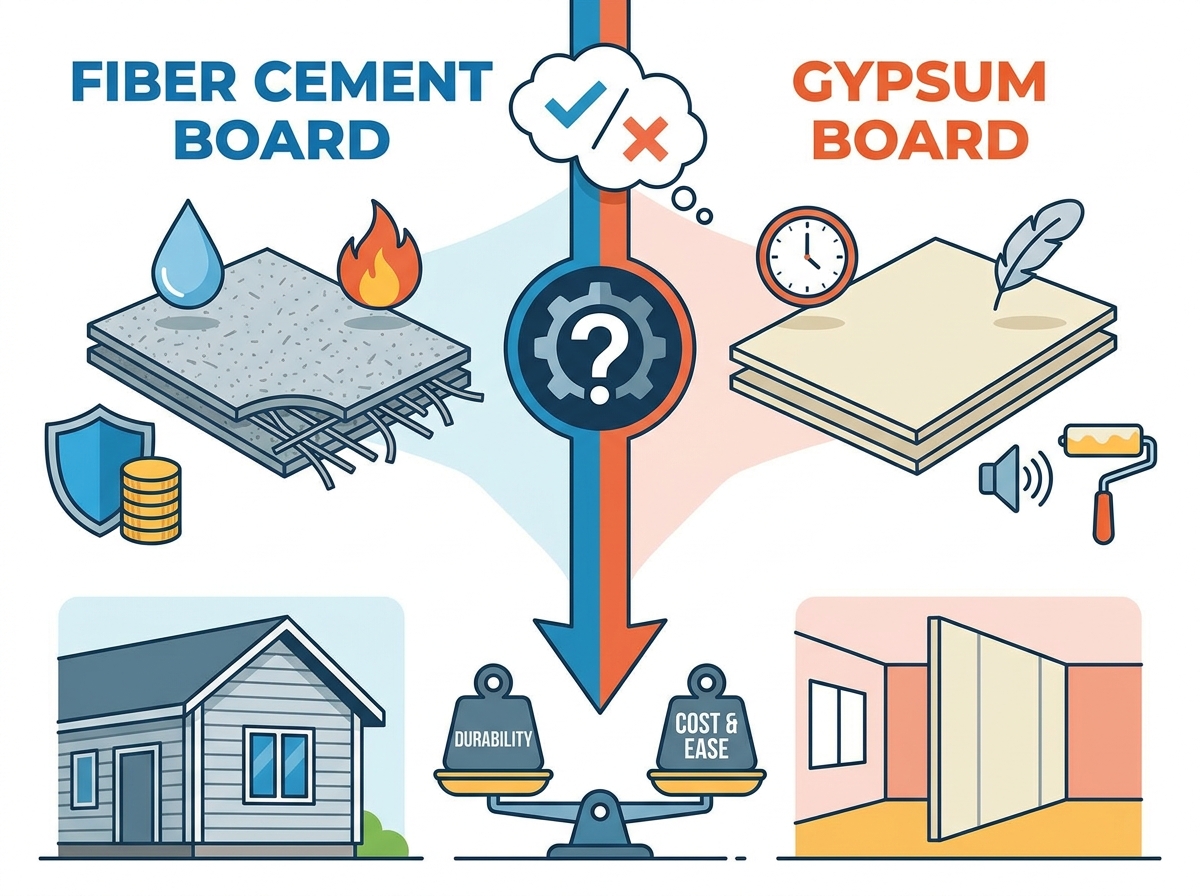
Continuous wet environments demand stable substrates. Shower enclosures, steam rooms, and exterior facades require materials that will not degrade when exposed to bulk water. Fiber cement performs exceptionally well here. It is not inherently waterproof and requires a liquid or sheet membrane to protect the framing behind it. However, the board itself will not disintegrate, swell, or lose structural integrity when wet.
Gypsum board exhibits catastrophic failure mechanics when exposed to water. The paper facing delaminates from the core. The calcium sulfate softens and turns to mush. This creates an ideal breeding ground for toxic mold. Standard drywall simply cannot survive continuous moisture exposure. Even a minor plumbing leak behind a drywall partition can necessitate complete removal and replacement of the affected area.
Shear strength and impact resistance dictate long-term durability. Fiber cement offers superior resistance to blunt force. It provides a rigid, unyielding surface necessary for heavy finishes. Large-format tile and natural stone installations require this rigidity. Deflection causes grout cracking and tile failure. When you install heavy travertine or marble, the substrate must remain perfectly static.
Gypsum board lacks the necessary point-load capacity for heavy finishes. It cannot support significant hanging weight without structural blocking behind the wall. Standard drywall flexes under pressure, making it unsuitable for heavy stone veneers or large ceramic tiles. If you attempt to bond heavy tile directly to standard drywall, the paper facing will eventually tear away from the gypsum core under the sheer weight of the finish.
Both materials offer non-combustible properties, but they achieve fire resistance differently. Type X gypsum board contains chemically combined water within its core. During a fire, this water releases as steam, slowing heat transmission. This makes it a staple in standard commercial fire partitions. It effectively compartmentalizes a building, giving occupants time to evacuate.
Fiber cement carries a Class A fire rating. It does not burn, melt, or release toxic fumes. Builders specify it frequently in exterior wildland-urban interface (WUI) zones. It provides a hardened exterior envelope against wildfires and extreme heat. When used as exterior siding or soffit material, it prevents embers from igniting the structural framing of the house.
Soundproofing capabilities vary significantly based on material density. Dense cement panels block low-frequency noise effectively. Standard gypsum board requires multiple layers to achieve similar attenuation. The sheer mass of a cement panel reflects sound waves, preventing them from passing through the wall assembly.
Material density directly impacts noise transmission loss across partition walls. Acoustic-grade gypsum utilizes constrained layer damping to reduce sound transfer. Achieving specific STC ratings in multi-family builds requires careful assembly configurations. You must utilize decoupling techniques, resilient channels, and acoustic insulation alongside your chosen substrate. Simply swapping drywall for cement board will not soundproof a room without addressing flanking paths and mechanical decoupling.
Performance Metric | Fiber Cement Board | Gypsum Board |
|---|---|---|
Moisture Tolerance | High (Requires surface membrane) | Low (Fails when wet) |
Load-Bearing Capacity | High (Supports heavy tile/stone) | Low (Requires blocking) |
Fire Resistance | Class A Non-combustible | Type X for rated assemblies |
Installation Speed | Slow (Requires specialized tools) | Fast (Score and snap) |
Impact Resistance | Excellent | Poor to Moderate |
Gypsum board installation relies on speed and simplicity. Installers use the rapid "score and snap" method. A standard utility knife is the only cutting tool required for straight lines. Crews fasten the panels using standard drywall screws. They finish the seams with paper tape and joint compound. A skilled crew can hang and tape an entire residential house in a matter of days.
Cement substrates require specialized tooling. You need carbide-tipped scoring tools, power shears, or diamond-blade circular saws. Fastening demands alkaline-resistant mesh tape. You must use specialized, corrosion-resistant screws to prevent fastener pull-through and rust. Standard drywall screws will corrode rapidly when embedded in alkaline cement, eventually snapping and causing the board to detach from the studs.
Weight disparity impacts labor fatigue directly. Cement panels are significantly heavier than drywall. They often require two-person lifts for safe handling, especially when installing ceiling panels or working on scaffolding. This slows down production rates on large job sites and increases the risk of musculoskeletal injuries among the workforce.
Cutting cement panels generates respirable crystalline silica dust. OSHA compliance mandates strict dust mitigation. Crews must use HEPA vacuums, wet-cutting techniques, and wear proper PPE. Gypsum dust acts primarily as a nuisance. It poses lower regulatory and health risks during standard installation, though masks are still recommended during the sanding phase of finishing.
Specify this material where moisture and heavy loads intersect. It excels in specific environments where standard building materials fail. We routinely deploy it in the following areas:
Interior wet zones including shower enclosures, tub surrounds, steam rooms, and bathroom floors.
High-humidity residential and commercial zones like kitchen backsplashes and commercial sink areas.
Exterior applications such as siding, soffits, fascia, and exterior ceilings.
High-heat areas acting as backing for wood stoves or fireplace surrounds.
Subfloor underlayment for heavy natural stone or large-format ceramic tile installations.
Deploy standard drywall in controlled, dry environments. It provides the most efficient coverage for interior spaces that will not see bulk water exposure. Use it for:
Interior dry zones including bedroom, living room, and hallway walls.
Commercial applications requiring rapid deployment of non-load-bearing partition walls.
Fire-rated corridor assemblies using Type X variants.
Ceiling assemblies in climate-controlled environments.
Modern construction increasingly favors dry assemblies over traditional brick-and-mortar masonry. Specifying gypsum and cement boards accelerates construction schedules significantly. It reduces the overall building weight, lowering structural foundation requirements. You do not need massive concrete footings to support a lightweight steel-stud and drywall partition.
These dry assemblies offer excellent seismic resilience. They flex slightly under stress, whereas rigid masonry cracks. A properly specified dry partition provides a 15+ year performance lifecycle. It delivers superior acoustic barriers when combined with proper insulation, outperforming single-layer masonry walls. The speed of installation allows other trades to begin rough-ins much faster than waiting for mortar to cure.
Initial expenditures differ drastically. Cement panels typically cost significantly more than standard drywall per square foot. You must also factor in increased labor time. A crew that can hang fifty sheets of drywall in a day might only manage twenty sheets of cement board due to the cutting difficulty and weight.
Specialized tooling and high-performance fasteners add to the baseline material costs. Dust mitigation equipment and slower cutting speeds increase billable labor hours. Gypsum provides the most economical path for rapid wall coverage in dry zones. If budget is the primary driver, you isolate the expensive cement board strictly to the areas that absolutely require it.
View the higher upfront cost of cement substrates as an insurance policy. It protects against catastrophic water damage in wet zones. Using standard drywall in a shower guarantees failure. The moisture will eventually penetrate the grout lines, saturate the drywall paper, and cause the tiles to fall off the wall.
Calculate the potential cost of rework. You will pay for mold remediation, structural framing repair, and complete tile replacement. Specifying the correct, moisture-stable board eliminates these future liabilities entirely. The return on investment is realized the moment a plumbing fixture leaks or a grout joint cracks, and the underlying substrate remains completely intact.
Procurement teams must verify technical specifications before purchasing. Look for strict compliance with ASTM standards. ASTM C1288 or C1325 certification ensures the material meets baseline performance metrics for flexural strength, moisture movement, and fastener pull-through resistance. Do not accept uncertified boards on commercial projects.
Assess the dimensional tolerances provided by the factory. Check the edge profiles available. Tapered edges allow for flush seam finishing with alkaline-resistant tape and thinset, while square edges work better for floor underlayment where you want a tight butt joint. Consistent manufacturing tolerances reduce installation headaches and prevent lippage in the final tile finish.
Review manufacturer warranties carefully. Look for exclusions related to improper framing or fastener selection. Many warranties void if you fail to apply secondary waterproofing membranes or if you use the wrong type of thinset mortar. Read the fine print regarding deflection requirements.
Prioritize manufacturers offering complete, tested assemblies. When you compare cement board manufacturers, look for those supplying the board, fasteners, tape, and waterproofing as a single system. This ensures single-source warranty liability. Evaluate their technical field support and regional supply chain reliability. If a failure occurs, you want one company responsible for the entire assembly, rather than multiple vendors pointing fingers at each other.
A common misconception assumes cement panels are waterproof. They are only water-resistant and dimensionally stable. Water will pass through the porous material and the seams. If you leave the board exposed in a shower, the wood studs behind it will eventually rot.
You must apply a topical liquid waterproofing membrane or a sheet membrane over the entire surface in wet zones. Pay special attention to corners, seams, and fastener penetrations. Tape all joints with alkali-resistant mesh tape and embed it in modified thinset before applying the waterproofing layer. Failure to waterproof the substrate allows moisture to reach the wall cavity.
The best backing board cannot compensate for weak framing. Tile cracking occurs if the underlying stud or joist framing flexes under load. You must meet minimum deflection criteria before hanging the first sheet of board. The substrate will simply transfer the movement to the rigid tile finish.
Ensure floor joists meet L/360 deflection standards for ceramic tile. Natural stone requires a stiffer L/720 rating. Reinforce framing with blocking or sistered joists before installing the substrate. A rigid foundation prevents surface finish failure. Check the walls for plumb and the floors for level; cement board will not hide framing imperfections.
Selecting the right substrate requires matching material properties to environmental realities. Gypsum delivers rapid, economical coverage for dry interior spaces. Cement panels provide the heavy-duty resilience required for wet zones and exterior applications. Follow these actionable steps for your next project:
Review local building codes to verify approved substrates for specific wet-zone and fire-rated assemblies.
Consult structural engineers to ensure floor and wall framing meets strict deflection criteria before installation.
Request technical data sheets from suppliers to verify ASTM compliance and warranty requirements.
Specify complete, integrated waterproofing systems from a single manufacturer to guarantee warranty coverage.
Train installation crews on proper dust mitigation and specialized cutting techniques for cement panels.
A: No. Building codes have largely banned green board in wet zones like shower enclosures. The paper facing and gypsum core degrade under continuous moisture exposure, leading to mold and tile failure. Green board is designed only for humid rooms, not direct water contact.
A: It is water-resistant and dimensionally stable, but not waterproof. Water can pass through its porous structure. You must apply a topical liquid or sheet waterproofing membrane over the board before installing tile in any wet area.
A: It consists of dense Portland cement and silica sand cured under high pressure. This creates a rigid, stone-like material requiring carbide or diamond-tipped tools. Gypsum board contains an aerated calcium sulfate core that easily scores and snaps.
A: Yes, but it requires specific preparation. You must use an alkali-resistant masonry primer to seal the porous surface. The texture is generally rougher than smooth gypsum, so it is rarely used for painted interior walls without a skim coat.
A: It provides excellent shear strength and impact resistance. However, it does not replace structural sheathing like OSB or plywood for load-bearing or bracing requirements unless specifically engineered and approved by a structural engineer.
A: The paper facing acts like a sponge through capillary action. The calcium sulfate core softens, loses structural integrity, and crumbles. This trapped moisture creates an ideal environment for rapid, toxic mold proliferation.
A: Yes. Drywall assemblies significantly reduce structural weight and accelerate construction schedules. They offer a 15+ year durable lifecycle, excellent seismic resilience, and superior acoustic barriers when properly insulated, making them highly economical compared to wet masonry.


