
Views: 0 Author: Site Editor Publish Time: 2026-07-03 Origin: Site


Specifying the wrong backing or cladding material leads to catastrophic project failures, including moisture intrusion, cracked tile assemblies, and compromised exterior envelopes. Builders and contractors face this issue frequently when choosing between panel products that sound similar but perform entirely differently. Understanding exactly what material belongs on the exterior wall versus the shower enclosure is the foundation of a lasting build.
Despite similar naming conventions, fiber cement board and traditional cement board possess fundamentally different structural compositions, tensile strengths, and ideal use cases. Misunderstanding these differences leads to costly rework and warranty voids. You cannot swap one for the other without risking the integrity of the entire assembly. The right choice depends on whether you need rigid support for heavy tile or flexible durability against wind and weather.
This guide breaks down the material science, performance metrics, installation realities, and lifecycle costs of both materials to ensure accurate specification for your next commercial or residential build.
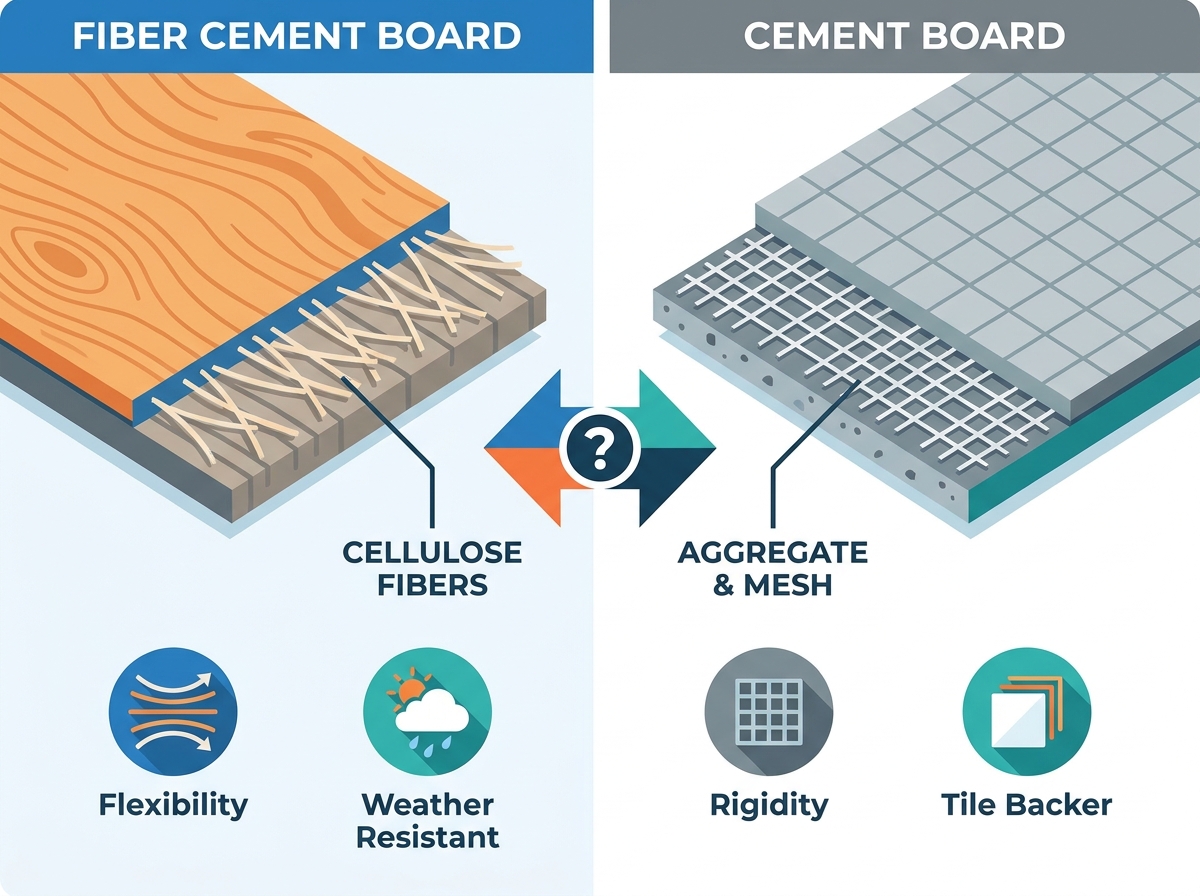
Composition Dictates Function: Traditional cement board relies on a fiberglass mesh for rigidity, making it the industry standard for heavy tile underlayment. Fiber cement board integrates cellulose fibers with raw mineral ingredients for flexibility and tensile strength, optimizing it for exterior cladding.
Moisture Management: While both are highly water-resistant, cement board will not degrade when continuously wet (ideal for showers), whereas fiber cement requires proper sealing, flashing, and ground clearance to prevent long-term edge swelling and warping from moisture absorption.
Installation Trade-offs: Fiber cement demands specialized cutting tools to manage hazardous silica dust and requires specific fastening systems to accommodate structural movement.
Sourcing Matters: Evaluating top cement board manufacturers based on warranty terms, regional climate testing, and compliance with local building codes is critical for long-term project viability.
Traditional cement board is manufactured using a straightforward mixture of Portland cement, sand, and water. This core is then encased in a continuous, heavy-duty fiberglass mesh on both sides. The mesh provides the necessary structural reinforcement to hold the brittle cement core together. We see this material constantly on job sites where heavy tile installations are underway.
The manufacturing reality results in a highly rigid, dense, and brittle panel. It resists compression exceptionally well, making it the perfect substrate for heavy materials. However, it lacks flexibility. If bent or subjected to significant structural movement, the panel will snap or crumble rather than flex. You rely on this rigidity to keep grout lines from cracking under the weight of large-format porcelain or natural stone.
Contractors must understand that the fiberglass mesh is alkali-resistant. Standard fiberglass would dissolve in the highly alkaline environment of Portland cement. This specific engineering detail ensures the board maintains its structural integrity over decades of use behind wet-area tile assemblies.
The engineering behind a fiber cement board involves Portland cement, silica sand, water, and refined cellulose fibers derived from wood or plants. The manufacturing process utilizes these raw earthy minerals and processes them through a high-pressure steam-curing autoclave. This intense heat and pressure chemically bind the cellulose fibers to the silicate-cement matrix.
The outcome is a panel where the cellulose adds tensile strength and slight flexibility. This prevents shattering under impact and allows for precise architectural shaping. The material can handle the expansion and contraction required for exterior applications without failing. We use this flexibility to our advantage when wrapping building exteriors that experience significant thermal cycling.
Autoclaving is what gives the board its dimensional stability. Without this high-pressure curing process, the material would shrink and expand wildly with humidity changes. The integration of cellulose fibers acts like microscopic rebar, holding the cementitious matrix together even when subjected to wind loads and minor building settling.
The internal structure distinction between these materials is significant. Fiber cement boards rely on microscopic cellulose fiber reinforcement spread evenly throughout the dense matrix. Cement particle boards use larger wood chips or shavings bound with cement.
These structural differences have major performance implications. Cement particle board is lighter but significantly more vulnerable to moisture swelling, structural decay, and fungal growth. The dense, autoclaved matrix of high-quality fiber cement resists these issues much more effectively, providing a more stable and durable cladding solution.
Feature | Traditional Cement Board | Fiber Cement Board | Cement Particle Board |
|---|---|---|---|
Primary Reinforcement | Fiberglass mesh (exterior faces) | Cellulose fibers (internal matrix) | Wood chips/shavings |
Flexibility | Extremely rigid, snaps under tension | Moderate flexibility, high tensile strength | Low flexibility, prone to breaking |
Moisture Reaction | Passes water, does not swell or rot | Resists water, can swell at unsealed edges | Absorbs water, high risk of swelling |
Primary Application | Tile underlayment, wet areas | Exterior cladding, siding, trim | Acoustic flooring, dry interior walls |
Cement board handles moisture differently than fiber cement. Capillary action allows water to pass through cement board, but the material itself does not rot, swell, or lose structural integrity when wet. Because water passes through it, cement board requires an independent waterproofing membrane in wet areas to protect the framing behind it. You apply liquid waterproofing or sheet membranes directly over the board before tiling.
Fiber cement is highly water-resistant but not entirely waterproof. Because of the organic cellulose content, prolonged exposure to standing water or failed joint seals can lead to edge swelling, delamination, and warping. Proper installation, including adequate ground clearance and sealed edges, is mandatory to prevent moisture absorption. We always prime and paint field-cut edges to lock out moisture.
When evaluating moisture performance on site, consider the following field tests and observations:
Check the ground clearance. Siding must sit at least six inches above grade to prevent wicking.
Inspect roofline intersections. Kickout flashing is required to direct water away from the cladding.
Verify edge sealing. All cut edges must be coated with 100% acrylic primer before installation.
Examine joint treatments. Use polyurethane or advanced polymer sealants, never standard silicone, for exterior joints.
Cement board offers high compressive strength but zero flex. It is designed to remain completely rigid. This rigidity is ideal for preventing deflection behind heavy stone or large-format tile, ensuring the grout joints do not crack under pressure. You want a dead-flat, unyielding surface when setting heavy materials.
Conversely, fiber cement provides high tensile strength. It can accommodate minor structural settling, thermal expansion, and wind loads without cracking. This flexibility makes it superior for exterior envelopes where the building must move slightly with environmental changes. It bends just enough to survive high winds but remains stiff enough to hold a straight line on a long wall.
Both materials offer Class A non-combustible fire ratings and are completely impervious to termites and wood-boring insects. They provide excellent protection for building envelopes and interior heat sources. We frequently specify these panels in wildland-urban interface zones where fire codes demand non-combustible exteriors.
Fiber cement holds a comparative advantage over natural wood. It mimics the texture of wood but resists fading, cracking, rotting, and ignition under direct flame exposure. When evaluating these materials, check manufacturer-specific ASTM testing, such as ASTM E136 for non-combustibility and ASTM C1186 for physical properties, to ensure compliance with project requirements.
Cement board is the standard for interior wet areas. It is the preferred substrate for shower enclosures, bathtub surrounds, and steam rooms where constant moisture is present. It will not degrade even if the waterproofing membrane fails slightly. We trust it to hold up under the harshest indoor moisture conditions.
It also serves as an excellent flooring underlayment for ceramic, porcelain, and natural stone tile, providing a rigid base that prevents cracked grout. Furthermore, cement board acts as effective heat shielding behind freestanding stoves, fireplaces, and outdoor kitchen framing. You can apply thin-set directly to it, knowing the bond will hold.
Custom shower pans and curbed enclosures.
Kitchen backsplashes requiring heavy stone mosaics.
Subflooring transitions over wood joists.
Heat shields for wood-burning stove surrounds.
Fiber cement excels in exterior cladding applications. It is widely used for lap siding, board and batten siding, architectural panels, and shingle formats. Its durability against the elements makes it a top choice for residential and commercial facades. We rely on it to deliver a traditional aesthetic without the maintenance nightmare of real wood.
Beyond siding, it is used for exterior architectural details like soffits, fascia, and trim. Internally, it can be specified as impact-resistant interior wall panels in high-traffic commercial corridors where drywall would easily dent or puncture. It takes a beating from carts and equipment without showing damage.
Exterior lap siding on residential developments.
Large-format architectural panels on commercial facades.
Vented soffit panels under roof eaves.
Wainscoting in heavy-use commercial hallways.
Fiber cement is dense and heavy, requiring two-person lifts for large panels to prevent cracking at the corners during transit on the job site. Cement board is also heavy but generally easier to maneuver in smaller interior spaces. You have to plan your material staging carefully to avoid worker fatigue and material damage.
Cutting cement board is relatively simple; it can be scored and snapped with a carbide-tipped utility knife, similar to drywall. Cutting fiber cement requires specialized polycrystalline diamond (PCD) blades or fiber cement shears to handle the dense material. Standard wood blades will burn out after just a few cuts.
Safety compliance is mandatory for both materials, as they generate respirable crystalline silica dust when cut. OSHA-compliant dust extraction, wet-cutting techniques, and HEPA vacuums are required during dry cutting to protect workers. We strictly enforce the use of respirators and dust-collecting saws on all our sites.
Set up a dedicated cutting station downwind from the main work area.
Equip all circular saws with PCD blades and attach them to HEPA-filtered vacuums.
Use electric shears for indoor cuts to eliminate airborne dust entirely.
Require all workers handling the material to wear N95 or P100 respirators.
Implement wet-cutting methods for thick architectural panels.
Cement board requires alkali-resistant fiberglass tape and modified thin-set mortar for treating joints. It must be fastened with corrosion-resistant cement board screws designed to countersink into the dense mesh without tearing it. Standard drywall screws will rust and fail, compromising the entire tile assembly.
Fiber cement requires blind nailing or face nailing with hot-dipped galvanized or stainless steel siding nails. Joints require specific flashing, caulking, or proprietary H-channel trims to manage expansion and prevent water intrusion behind the cladding. You must hit the studs with every fastener; shooting into just the OSB sheathing will result in blow-offs during high winds.
Cement board is generally cheaper per square foot for interior applications. You must account for the additional budget required for waterproofing membranes and specialized thin-set mortar to complete the assembly. The board itself is just one component of a multi-step waterproofing system.
Fiber cement carries a higher initial material cost. It also requires specialized installation labor, scaffolding, and precision tooling, which increases the upfront installation expenses significantly compared to basic wood or vinyl siding. The labor rate for a crew experienced in handling heavy, dust-producing panels is naturally higher.
Cement board requires essentially zero maintenance once enclosed behind tile or stone. It sits undisturbed and performs its structural duty for the life of the assembly. As long as the grout and sealant joints are maintained, the backing board will outlast the building.
Fiber cement requires periodic maintenance. To maintain moisture warranties and prevent warping, it needs repainting and recaulking of joints, typically every 10 to 15 years, depending on climate exposure. We advise building owners to inspect the caulking around windows and doors annually to catch any sealant failures early.
When vetting manufacturers, look for ICC-ES evaluation reports and compliance with ASTM C1325 for cement board or ASTM C1186 for fiber cement. These standards verify the material's physical properties and durability. You want documented proof that the panel will perform under stress.
Analyze warranty exclusions carefully. Many manufacturers void warranties if specific fastening patterns, joint clearances, or ground-clearance requirements are ignored during installation. Ensure your framing and installation crews understand these requirements. We have seen claims denied simply because the contractor used the wrong type of nail or failed to leave a 1/4-inch gap above the flashing.
Assess manufacturers based on their product lines engineered for specific climate zones. For example, look for freeze-thaw resistance in northern climates versus high-humidity, fade-resistant formulations in southern zones. Sourcing from top cement board manufacturers with robust local distribution ensures material availability and timely project completion. You cannot afford to have a crew standing around waiting for a specialized trim piece to ship from across the country.
Evaluate your project based on three criteria: moisture exposure type, required structural flexibility, and finishing material. The choice between these boards dictates the long-term survival of your wall assemblies.
Review local building codes for exterior cladding requirements and wind-load ratings before ordering materials.
Consult with a structural engineer regarding load-bearing limits for heavy tile assemblies over wood-framed floors.
Request physical samples and technical data sheets from manufacturers to verify compatibility with your chosen sealants and finishes.
Audit your tool inventory to ensure you have the necessary PCD blades, shears, and HEPA vacuums for safe installation.
A: No. It is highly water-resistant but can absorb moisture over time if not properly sealed, painted, or flashed. It should not be used in areas with standing water.
A: While some manufacturers approve specific fiber cement products for wet areas, traditional glass-mesh cement board is widely considered the superior, lower-risk choice for tile underlayment in showers.
A: Fiber cement board is typically denser and heavier per square foot than traditional cement board, making it more difficult to handle on job sites and requiring proper fastening support.
A: Due to high silica content, it must be cut using specialized fiber cement shears or a circular saw equipped with a PCD blade and an OSHA-compliant HEPA dust extraction system.
A: Yes, it can be used for exterior applications like outdoor kitchens or as a substrate for exterior stone veneer, provided it is covered with an appropriate weather-resistant barrier and finish.
A: Warping is typically caused by improper installation, such as inadequate ground clearance, failing to seal cut edges, or incorrect fastening techniques that restrict the board's natural expansion and contraction.


