
Views: 0 Author: Site Editor Publish Time: 2026-07-17 Origin: Site


The historical reliance on asbestos in construction materials left a legacy of health risks, making the transition to modern, safe composites a priority for commercial and residential builders. For decades, contractors prioritized tensile strength and fire resistance without fully understanding the severe respiratory hazards associated with legacy materials. Buyers must navigate a crowded market to source modern fiber cement board that guarantees safety without sacrificing the durability, fire resistance, and structural integrity required by stringent building codes. A misstep in procurement can lead to structural failures, code violations, or significant occupational hazards during installation. This guide provides an evidence-based framework for evaluating asbestos free fiber cement board. We detail performance metrics, installation realities, and lifecycle value to inform high-stakes procurement decisions. You will learn how to verify safety claims, compare structural weight ratios, and manage the hidden complexities of modern cladding and underlayment systems.
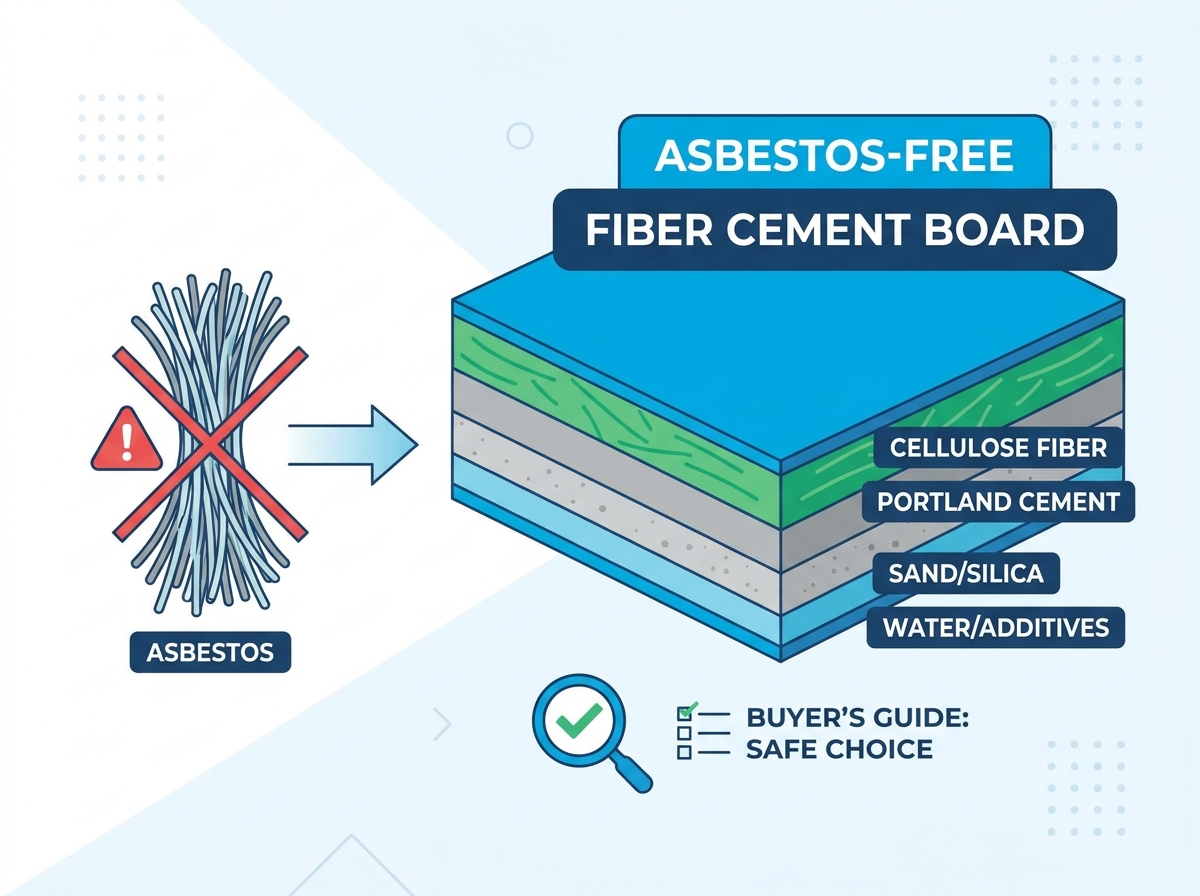
Material Composition: Modern asbestos free fiber cement board utilizes a matrix of Portland cement, silica sand, and cellulose fibers to achieve high tensile strength and dimensional stability.
Performance vs. Weight: While offering top-tier fireproofing and moisture resistance, the material is significantly heavier than engineered wood or vinyl, though it remains a fraction of the weight (approx. 30%) of traditional concrete slabs.
Installation Risks: Safe implementation requires strict silica dust mitigation protocols and specialized cutting tools to prevent material failure and ensure occupational safety.
Lifecycle Value: Despite higher upfront labor and material costs, the long-term ROI is justified by a 30-to-50-year lifespan and reduced susceptibility to rot, pests, and combustion.
Historically, the construction industry relied heavily on asbestos to provide tensile strength and fire resistance in building materials. Manufacturers mixed these naturally occurring silicate minerals into cement to create durable panels that could withstand harsh environmental conditions. The severe health risks associated with fiber release—specifically mesothelioma, asbestosis, and other lung diseases—eventually led to widespread bans and strict regulations. The legacy of these materials remains a significant challenge for renovation and demolition projects today. Contractors frequently encounter these hazardous panels when updating exterior cladding or interior fire barriers on structures built before the late 1980s. Managing this legacy requires strict adherence to abatement protocols to protect workers and building occupants from airborne particulates.
The danger of legacy materials extends beyond active disturbance during demolition or remodeling. Gradual environmental exposure, freeze-thaw cycles, and acid rain cause old asbestos-cement sheets to dissolve and weather over time. This degradation slowly releases harmful airborne fibers from aging structures into the surrounding environment. As the cement binder breaks down, the microscopic fibers become friable, posing a continuous inhalation risk. Field inspections of older buildings often reveal chalky, deteriorating surfaces on exterior panels, indicating that the cementitious matrix has failed and fibers are actively shedding into the soil and air.
To eliminate these hazards, manufacturers transitioned to cellulose fiber reinforcement. Modern production utilizes an autoclave curing process that bonds Portland cement, silica sand, and wood pulp under high pressure and temperature. This method creates a stable, non-hazardous composite that matches or exceeds the performance of legacy materials. The resulting panels offer excellent dimensional stability and resistance to environmental stress without the associated health risks. The autoclave process accelerates the curing of the cement, ensuring the panels achieve their maximum strength before they leave the factory floor. This controlled manufacturing environment guarantees consistent density and structural integrity across every batch.
Establishing clear success criteria for procurement is essential to ensure site safety and regulatory compliance. Relying solely on a manufacturer's marketing claims is insufficient for commercial procurement.
Request Material Safety Data Sheets (MSDS) directly from the manufacturer to confirm the exact chemical composition of the panels.
Demand independent laboratory testing certificates that verify the complete absence of asbestos fibers in the finished product.
Identify trusted global brand benchmarks that operate transparent, audited manufacturing facilities.
Exercise extreme caution with imported, non-certified, or heavily discounted legacy materials that may bypass stringent quality controls and local building codes.
Evaluating the strength-to-weight ratio of modern formulations is critical for structural planning. Modern boards offer exceptional strength at only approximately 30% of the weight of traditional cast-in-place concrete slabs. This significant weight advantage reduces the dead load on building frames and simplifies foundation requirements. Modern panels meet rigorous structural floor load requirements and impact resistance standards, making them highly suitable for high-traffic commercial spaces or demanding exterior applications. When used as a tile underlayment, the panels provide a rigid, deflection-free substrate that prevents grout cracking and tile delamination under heavy foot traffic.
The multi-application utility of modern boards extends across both interior and exterior environments. Their dimensional stability and resistance to environmental degradation make them ideal for external wall cladding, soffits, and fascia boards. Internally, they serve effectively as ceiling panels, robust partition walls, and high-moisture floor underlayments in bathrooms and commercial kitchens. This versatility allows builders to standardize materials across different phases of a project, streamlining procurement and installation. Using a single material type for multiple assemblies reduces waste and simplifies the supply chain for large-scale developments.
Fire safety is a primary driver for selecting these composites. They achieve non-combustible ratings, often meeting Class A fire ratings and ASTM E136 standards. Under extreme heat, the material does not ignite, melt, or release toxic fumes. This behavior plays a role in creating fire-rated wall assemblies, providing vital evacuation time and limiting fire spread in both residential and commercial structures. In wildland-urban interface areas, these panels are frequently specified to protect exterior walls from radiant heat and flying embers during wildfire events.
Analyzing the material's porosity reveals low water absorption rates and inherent resistance to fungal decay. Unlike wood-based products, it does not provide a food source for termites or other wood-boring insects. Achieving maximum durability requires proper sealing and priming. Unsealed cut edges can absorb moisture, leading to delamination or freeze-thaw damage in extreme climates. Proper finishing ensures the material maintains its structural integrity over decades of exposure. Installers must pay close attention to flashing details and weather barriers to prevent water from accumulating behind the panels.
Performance Metric | Modern Composite Panels | Engineered Wood | Traditional Concrete |
|---|---|---|---|
Fire Rating | Class A / Non-Combustible | Combustible | Non-Combustible |
Weight Profile | Moderate (approx. 2.5 lbs/sq ft) | Lightweight | Heavy (approx. 12.5 lbs/sq ft) |
Moisture Resistance | High (requires sealed edges) | Moderate (prone to swelling) | High |
Pest Resistance | Impervious | Vulnerable | Impervious |
The physical weight of the panels presents logistical challenges compared to lightweight alternatives like vinyl or engineered wood. Handling these dense sheets directly impacts labor hours. Standard installation typically requires two-person teams for maneuvering and positioning. For commercial facades or multi-story applications, specialized lifting equipment becomes necessary, increasing overall project costs and requiring careful site coordination. Contractors must factor in increased fatigue and slower installation rates when estimating labor requirements for large exterior cladding jobs.
Cutting these panels generates respirable crystalline silica, a recognized occupational hazard. Inhaling silica dust can lead to silicosis and other severe respiratory conditions. Strict mitigation strategies are mandatory on all job sites.
Utilize HEPA-filtered vacuums attached directly to circular saws and routers.
Employ polycrystalline diamond (PCD) saw blades designed specifically to minimize dust production and maintain sharp cutting edges.
Use pneumatic or electric shears for straight cuts to eliminate airborne dust entirely.
Ensure all workers wear OSHA-compliant respiratory protection during cutting, drilling, and cleanup operations.
Installation requires specific hardware to prevent long-term failure. You must use corrosion-resistant fasteners, such as hot-dipped galvanized or stainless steel nails and screws. Blind nailing techniques are often employed to conceal fasteners and protect them from weather exposure. Claims of constant maintenance are often overstated. The reality involves periodic inspections of caulked joints and repainting intervals that typically range from 10 to 15 years, depending heavily on local environmental exposure and the quality of the initial factory or field-applied coating.
When comparing these two popular options, distinct advantages emerge. The cementitious composite clearly wins in moisture resistance and fire ratings, offering superior protection against rot and combustion. Engineered wood wins in ease of installation and weight. It is lighter, easier to cut with standard high-speed steel blades, and generally requires less specialized labor, making it a faster option for framing crews working on tight schedules.
The choice between these materials often comes down to budget versus durability. The composite panel wins in aesthetic versatility and impact resistance, providing a solid, premium feel that mimics natural wood grain without the hollow sound of plastics. Vinyl offers lower upfront material costs and easier installation. Vinyl has a higher vulnerability to extreme weather, including significant thermal expansion, warping under high heat, and becoming brittle and prone to cracking in freezing temperatures.
Traditional stucco provides a seamless aesthetic but comes with significant installation challenges. Stucco requires specialized masonry skills, multiple coats, and extended curing times, slowing down construction schedules. It carries a high risk of cracking due to building settlement or thermal movement. Panelized systems offer faster installation speeds, consistent factory-controlled quality, and lower long-term maintenance requirements, particularly in climates with significant temperature fluctuations and seismic activity.
Ensuring compliance requires evaluating materials against critical industry standards. For flat non-asbestos sheets, ASTM C1186 is the primary evaluation lens, dictating physical and mechanical property requirements. Regional compliance is equally important. Projects in hurricane zones require specific wind-load testing certifications and enhanced fastening schedules, while builds in wildland-urban interface areas demand strict adherence to exterior fire exposure standards and ignition-resistant construction protocols.
Renovating older structures often involves encountering hazardous legacy materials. Proper identification and handling are non-negotiable.
Inspect the age of construction; buildings erected before the late 1980s carry a high probability of containing hazardous materials.
Look for trademark stamps on the back of panels or note specific textures, such as golf-ball-like dimpled surfaces common in older siding.
Safe removal must follow regional clean air authority regulations, including continuous wetting of the panels to prevent fiber release.
Strictly avoid sanding, scraping, or breaking the material during the removal process.
Waste must be double-bagged in 6-mil plastic and disposed of at certified hazardous waste facilities.
Request comprehensive technical data sheets and independent lab testing certificates from prospective suppliers to verify performance metrics and safety claims.
Consult with structural engineers to confirm load-bearing requirements and verify that the building frame can support the dead load of the panels.
Audit your chosen contractor's safety protocols to ensure they have documented experience with silica-safe installation practices and possess the required HEPA-filtered tooling.
Specify corrosion-resistant fasteners and high-quality elastomeric sealants in your procurement documents to prevent premature joint failure.
A: Request the Material Safety Data Sheet (MSDS) and independent laboratory testing certificates from the manufacturer. Ensure the documentation explicitly states the product is 100% free of asbestos and relies on cellulose fibers for reinforcement.
A: Yes. While it is heavier than engineered wood or vinyl, it offers exceptional strength at only approximately 30% of the weight of a traditional cast-in-place concrete slab, reducing structural dead loads.
A: The primary disadvantages are its heavy weight, which increases labor costs and handling difficulty, and the generation of hazardous silica dust during cutting, which requires strict mitigation protocols and specialized tools.
A: Yes. While free of asbestos, the panels contain silica sand. Cutting or drilling the material generates respirable crystalline silica dust, requiring HEPA vacuums and OSHA-compliant respiratory protection during installation.
A: Yes. Its dimensional stability and moisture resistance make it highly versatile. It is commonly used for exterior wall cladding, interior partition walls, ceiling panels, and as a durable underlayment for tile floors.
A: The safest method involves using tools equipped with HEPA-filtered dust extraction vacuums and polycrystalline diamond (PCD) saw blades. Workers must also wear appropriate, OSHA-compliant respirators to prevent inhalation of silica dust.


