
Views: 0 Author: Site Editor Publish Time: 2026-07-22 Origin: Site


Bathroom wall failures—ranging from compromised waterproofing to mold proliferation and cracked grout—are disproportionately caused by improper substrate selection rather than the tile finish itself. Contractors, remodelers, and DIYers must balance material costs, installation efficiency, and long-term structural integrity. While lightweight foam alternatives are gaining market share, traditional heavy-duty substrates like fiber cement board remain a staple, creating confusion around the optimal choice for wet-area applications. This evaluation analyzes the structural, financial, and operational realities of using this material for bathroom walls, comparing it against modern alternatives to determine where it fits in a professional tile assembly. We will look at the exact mechanical properties, installation requirements, and waterproofing mandates that dictate a successful, code-compliant shower or tub surround build.
Water Resistance vs. Waterproofing: Fiber cement board is unaffected by moisture and will not rot, but it is highly porous and requires an independent waterproofing membrane (liquid or sheet) to protect the wall cavity.
Unmatched Compressive Strength: It provides superior rigidity and load-bearing capacity, making it the optimal substrate for heavy, large-format natural stone or porcelain tiles.
Implementation Trade-offs: While the raw material cost is significantly lower than extruded polystyrene (XPS) foam boards, the labor costs are higher due to its heavy weight, tool-wearing cutting process, and hazardous silica dust mitigation requirements.
System Compatibility: Fiber cement board requires strict adherence to manufacturer-specific fastening, taping, and waterproofing protocols to prevent joint failure and moisture intrusion.
Fiber cement board is a highly engineered building material composed of Portland cement, fine silica sand, water, and cellulose fibers. During the manufacturing process, these raw materials are mixed into a slurry, formed into sheets, and then cured in a high-pressure steam autoclave. The Portland cement provides the raw compressive strength and hardness, while the cellulose fibers act as a microscopic reinforcing matrix. This fiber network gives the board its tensile strength and flexibility, preventing it from shattering under impact or cracking during structural settling. Unlike older aggregate-based cement boards that rely on a fiberglass mesh facing, the reinforcement in fiber cement is distributed evenly throughout the entire core of the panel.
In the construction industry, materials must meet specific performance benchmarks. For fiber cement backer boards, the primary standard is ASTM C1288 (Standard Specification for Discrete Non-Asbestos Fiber-Cement Interior Linework). Compliance with this standard ensures the board meets minimum requirements for flexural strength, moisture movement, and dimensional stability. When you pull a sheet off the pallet, you know it has been tested to handle the specific stresses of a tile assembly without degrading.
Within the bathroom environment, this material serves as the primary substrate for areas subjected to direct water exposure or high humidity. You will find it used extensively in custom shower enclosures, tub surrounds, wainscoting, and bathroom floors. It acts as the structural bridge between the wood or metal framing and the final tile finish, providing a rigid, flat surface that will not rot when exposed to the inevitable moisture present in these zones.
A massive point of failure in bathroom remodels comes from misunderstanding the difference between "moisture-resistant" and "waterproof." Fiber cement is moisture-resistant. If you submerge a piece of it in a bucket of water for a month, it will not disintegrate, swell, or lose its structural integrity. However, it is highly porous. It acts like a rigid sponge. If water gets behind the tile and grout, the board will absorb it and allow it to pass straight through to the wood studs and insulation behind it. Capillary action will pull moisture through the panel. Therefore, you must apply a dedicated waterproofing membrane over the face of the board to stop water before it enters the substrate.
Regarding mold mitigation, fiber cement offers a distinct advantage over traditional building materials. Mold requires three things to grow: moisture, favorable temperatures, and an organic food source. Traditional drywall uses paper facing, which is an all-you-can-eat buffet for mold spores. Fiber cement contains no organic facing. The cellulose fibers are locked within the cementitious matrix. As long as the wall cavity remains dry through proper surface waterproofing, mold has nothing to feed on, drastically reducing the risk of fungal growth in your wall assembly.
When building a shower, wall deflection is your worst enemy. If the wall flexes when someone leans against it, the rigid thin-set mortar and grout will crack, leading to water intrusion and loose tiles. The Tile Council of North America (TCNA) requires a maximum deflection rating of L/360 for standard tile installations, and L/720 for natural stone. Fiber cement board provides exceptional rigidity, easily meeting these deflection standards when installed over properly spaced framing. It locks the wall assembly together, creating a monolithic structure that resists movement.
This rigidity translates directly to superior weight-bearing capabilities. Modern bathroom designs frequently incorporate heavy materials like 3/4-inch marble slabs, dense large-format porcelain tiles, or thick glass mosaics.
Fiber cement board can support up to 15 pounds per square foot of tile weight when properly fastened.
It resists point-load compression, meaning heavy tiles won't crush the substrate during installation.
The dense core prevents fastener pull-out, ensuring the board stays anchored to the studs under heavy shear loads.
It maintains its structural integrity even if the thin-set mortar is applied in thicker beds to compensate for uneven tiles.
Bathrooms are extreme microclimates. They experience rapid swings in temperature and humidity every time someone takes a shower. Materials that expand and contract significantly under these conditions will cause the tile assembly to fail. Fiber cement board exhibits excellent dimensional stability. Its thermal and moisture expansion coefficients are incredibly low. It stays flat and stable, ensuring the grout joints remain intact over decades of use.
In specialized environments like continuous-use commercial steam showers or residential saunas, the substrate faces relentless moisture vapor drive. Fiber cement holds up structurally in these high-heat, high-humidity zones. However, because of the intense vapor pressure, it must be paired with a high-performance vapor retarder (like a specialized sheet membrane) to prevent steam from penetrating the wall cavity and condensing on the cold framing members.
For adhesion, the manufacturing process leaves one side of the board with a distinct, textured finish. This rough surface is engineered specifically to create a mechanical key for polymer-modified thin-set mortars. When you trowel the mortar onto the board, it bites into this texture, creating a bond that is often stronger than the tile itself.
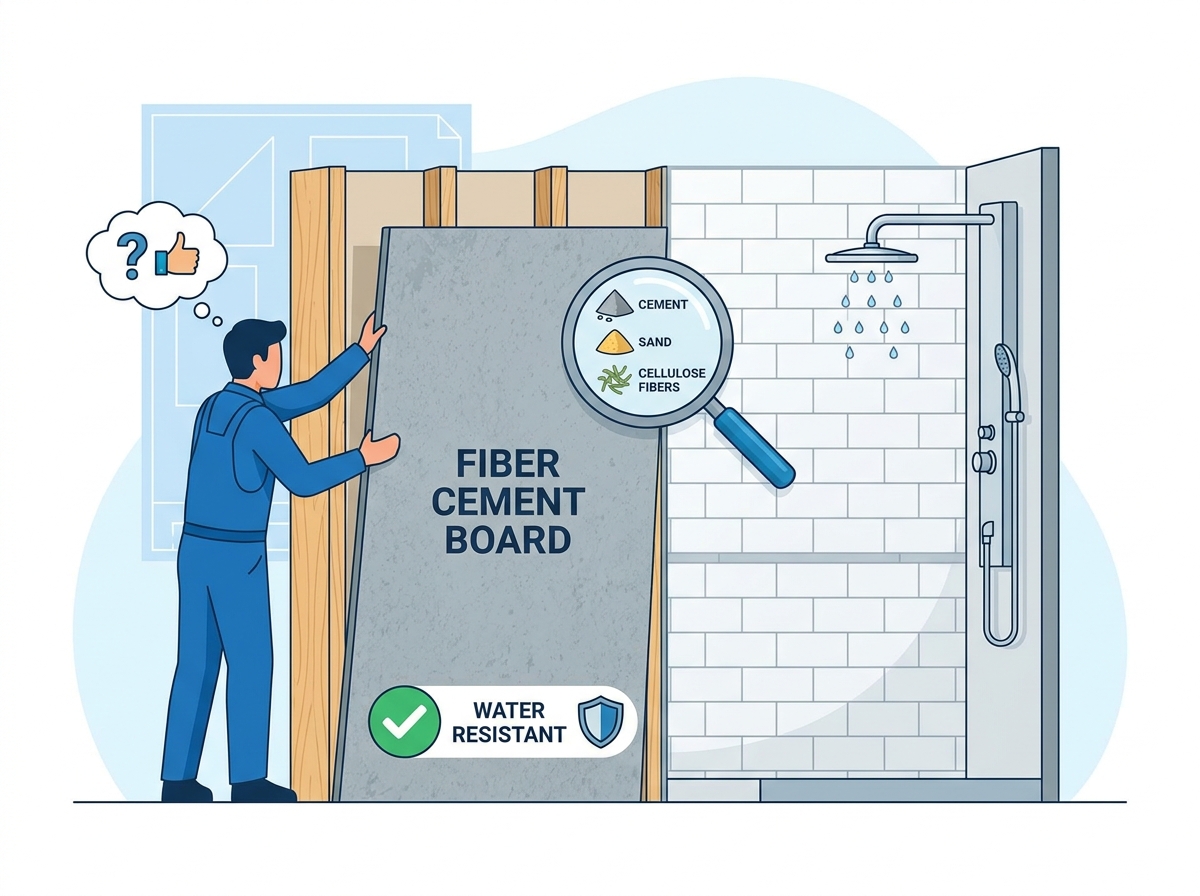
While often confused, fiber cement and traditional cement board (like Durock or WonderBoard) have different compositions. Traditional cement board uses a core of aggregated Portland cement wrapped in a fiberglass mesh on the front and back. Fiber cement uses cellulose fibers blended throughout the core.
On the job site, this means fiber cement is generally denser and stiffer. When you cut traditional cement board, the aggregate core tends to crumble, leaving rough edges that can be difficult to tape and mud. Fiber cement cuts cleaner, leaving a sharper edge. However, because it is so dense, you cannot use standard drywall screws. You must use specialized self-drilling fasteners with nibs under the head to countersink into the board; otherwise, the screw heads will mushroom the material and sit proud of the surface, interfering with the tile layout.
The industry is currently experiencing a massive shift toward extruded polystyrene (XPS) and expanded polystyrene (EPS) foam backer boards (like Wedi, GoBoard, or Kerdi-Board). These boards are incredibly lightweight and come with a factory-applied waterproof coating. A single worker can easily carry multiple sheets up a flight of stairs and cut them with a standard utility knife without generating any dust.
Despite these advantages, many veteran tile setters resist the transition. There is a deep-seated trust in the sheer mass and mechanical bond strength of cementitious products. Foam boards can dent or compress under heavy point loads or impact. If you are installing a heavy, floating shower bench or working with massive stone slabs, the compressive strength of fiber cement provides a level of structural confidence that foam cannot match.
Feature | Fiber Cement Board | XPS Foam Board | Traditional Cement Board |
|---|---|---|---|
Weight per 3x5 Sheet | Approx. 30-40 lbs | Approx. 4-6 lbs | Approx. 35-45 lbs |
Waterproof out of box? | No (Requires membrane) | Yes (Core or surface) | No (Requires membrane) |
Cutting Method | Score/Snap, Shear, Saw | Utility Knife | Score/Snap, Saw |
Compressive Strength | Extremely High | Moderate | High |
Dust Generation | High (Silica) | None | Moderate |
Moisture-resistant drywall, commonly known as green board, has a water-resistant paper facing and a slightly modified gypsum core. Decades ago, it was commonly used behind tile in showers. Today, building codes and the TCNA strictly prohibit the use of green board in wet areas like shower enclosures and tub surrounds. When water inevitably bypasses the grout, the gypsum core turns to mush, and the paper facing breeds mold, leading to catastrophic wall failure.
Green board is only acceptable in dry bathroom zones—the walls outside the shower footprint. For any area subject to direct water spray, utilizing fiber cement board for bathroom walls is the baseline standard for ensuring a durable, code-compliant installation.
When estimating a job, looking only at the per-sheet price is a mistake. The raw material cost of fiber cement is significantly lower than premium foam boards. However, the total installed cost narrows that gap considerably.
You must factor in the hidden costs of the required system components. You cannot tape the seams with standard drywall tape; you need alkali-resistant fiberglass mesh tape. You need specialized, corrosion-resistant screws. You will burn through carbide scoring tools or specialized saw blades. Most importantly, you must purchase and apply a liquid or sheet waterproofing membrane over the entire surface. When you add the cost of these materials and the extra labor hours required to install them, the financial advantage of fiber cement shrinks.
The physical toll of working with this material is substantial. A standard 1/2-inch, 3x5-foot sheet weighs heavily on the installer. Moving a dozen sheets into a second-story bathroom is exhausting. Installing it on ceilings or high walls almost always requires a two-person lift to prevent injury and ensure accurate placement.
The most critical risk factor is silica dust. Cutting fiber cement with an abrasive blade generates respirable crystalline silica. Inhaling this dust causes silicosis, an incurable and fatal lung disease. OSHA strictly regulates silica exposure on job sites.
Score and Snap: Use a carbide-tipped scoring knife to cut through the fiberglass mesh and score the cement core, then snap the board over a straight edge. This generates minimal dust.
Electric Shears: Specialized power shears bite through the material without spinning a blade, producing heavy chips instead of airborne dust.
Dust-Extracting Saws: If you must use a circular saw, it must be equipped with a HEPA-filtered dust extractor and a specialized polycrystalline diamond (PCD) blade.
The dense composition of the board will rapidly destroy standard utility blades, reciprocating saw blades, and drill bits. You must factor tool degradation into your operational costs.
The framing behind the board must be structurally sound. Studs must be spaced a maximum of 16 inches on center. If the framing is bowed or out of plumb, the rigid fiber cement will not bend to hide the imperfections; it will transfer that wave directly to your tile surface. You must shim or sister the studs flat before hanging the board.
Fastening requires specific hardware. Use 1-1/4 inch or 1-5/8 inch high-low thread cement board screws. Drive them every 8 inches along the studs. Keep fasteners at least 3/8 inch away from the board edges to prevent blowouts.
Once hung, leave a 1/8-inch gap between all sheets. Pack these joints with polymer-modified thin-set mortar and immediately embed a 2-inch wide alkali-resistant fiberglass mesh tape into the wet mud. Smooth it flat with a taping knife. This process unifies the individual panels into a single, continuous structural envelope.
Building a waterproof shower is an exercise in managing water gravity and capillary action. The substrate must integrate perfectly with the shower pan.
Framing Preparation: Ensure studs are plumb, flat, and spaced 16 inches on center.
Hanging the Board: Install the panels horizontally, staggering the vertical seams. Leave a 1/4-inch gap at the bottom where the board meets the shower pan flange or tub lip. Never let the board sit directly in the mud bed or on the tub deck, as it will wick water upward.
Fastening: Secure the panels using the correct screw schedule.
Joint Treatment: Mud and tape all seams and corners with thin-set and alkali-resistant tape.
Waterproofing: Apply the continuous membrane over the entire surface, overlapping the pan flange to direct water into the drain assembly.
Liquid elastomeric membranes are the most common waterproofing method used over fiber cement. These products are applied with a heavy nap roller or a trowel. They go on as a thick liquid and cure into a rubberized, flexible barrier.
The critical factor here is mil thickness. You cannot just paint it on like primer. You must achieve the manufacturer's specified wet film thickness (often checked with a wet film gauge) to ensure the final dry film thickness is sufficient to bridge micro-cracks and stop water. This usually requires at least two heavy coats, with the second coat applied perpendicular to the first. You must also pre-treat all corners, seams, and fastener heads with a heavy coat of the liquid before rolling the main field.
Pliable sheet membranes offer an alternative to liquid systems. These are rolls of waterproof polyethylene or similar synthetic materials covered in an anchoring fleece. You apply them to the fiber cement board by combing unmodified thin-set mortar onto the wall with a V-notch trowel and embedding the sheet into the wet mud, smoothing out all air bubbles with a flat trowel.
Sheet membranes provide a guaranteed, uniform thickness across the entire wall. There is no guessing if you rolled it on thick enough. Furthermore, they offer superior vapor permeance ratings. In a steam shower, a standard liquid membrane will allow too much moisture vapor to pass through. A high-performance sheet membrane acts as both a waterproof barrier and a vapor retarder, protecting the framing from steam drive.
A common and catastrophic error in shower construction is the "moisture sandwich." In the past, installers would staple a 4-mil polyethylene plastic sheet to the studs, hang the cement board over it, and tile directly on the board. The plastic protected the studs.
Today, we waterproof the front of the board. If you put plastic on the studs AND a waterproofing membrane on the front of the fiber cement, you have created a trap. Any condensation that forms inside the wall cavity, or any moisture that manages to bypass the front membrane, gets trapped inside the fiber cement board between two impermeable layers. It cannot dry out. This trapped moisture will eventually degrade the fasteners and breed mold in the framing. You must choose one method: either a vapor barrier behind the board (old school) or a topical waterproofing membrane on the face of the board (modern standard). Never use both.
Assess your framing layout and ensure studs are 16 inches on center and perfectly plumb before purchasing heavy substrate materials.
Select a TCNA-approved topical waterproofing system (liquid or sheet) that matches the specific moisture demands of your project, especially if building a steam shower.
Invest in the correct carbide scoring tools or dust-extracting equipment to maintain OSHA compliance and protect your lungs during installation.
Calculate the total installed cost, including specialized screws, alkali-resistant tape, and waterproofing membranes, rather than just the raw board price.
A: No. It is moisture-resistant, meaning it will not rot, swell, or lose structural integrity when exposed to water. However, it is highly porous and will allow water to pass through it into the wall cavity. You must apply a separate liquid or sheet waterproofing membrane over the surface.
A: No, not if you are applying a topical waterproofing membrane on the front of the board. Installing a barrier behind the board and a membrane on the front creates a trap that prevents condensation from drying, leading to structural failure.
A: Use the score-and-snap method. Score the face of the board deeply with a carbide-tipped scoring knife along a straight edge, then snap the board backward along the line. This method creates clean breaks and generates almost zero hazardous silica dust.
A: In dry areas like a kitchen backsplash, yes. In wet areas like a shower or tub surround, absolutely not. Water will penetrate the grout, soak the board, and eventually rot the wood framing behind it. Waterproofing is mandatory.
A: The rough, textured side should face out into the room. This texture is specifically engineered to provide a mechanical key, allowing the thin-set mortar to grip the board securely. The smooth side goes against the wall studs.
A: Traditional cement board uses an aggregate cement core wrapped in fiberglass mesh. Fiber cement blends cellulose fibers directly into the cement matrix. Fiber cement is generally denser, stiffer, and cuts with cleaner edges, though both require surface waterproofing.
A: Leave a 1/4-inch gap between the bottom of the board and the pan flange to prevent water wicking. Fill this gap with a flexible, mold-resistant 100% silicone sealant. Ensure your surface waterproofing membrane overlaps the pan flange to direct water into the drain.


