
Views: 0 Author: Site Editor Publish Time: 2026-07-26 Origin: Site


Modern construction demands sheathing materials that deliver uncompromising fire ratings, moisture resistance, and structural longevity, moving the industry away from traditional gypsum and plywood. Specifying the wrong architectural board leads to costly downstream failures. You risk moisture degradation in exterior cladding, joint cracking from structural deflection, or failure to meet stringent commercial fire codes. To mitigate these risks, project managers and architects must understand the precise structural, thermal, and operational differences between calcium silicate board and fiber cement board. Selecting the correct substrate requires analyzing environmental exposure, load-bearing requirements, and fire safety standards. This guide provides an objective, spec-by-spec evaluation to drive accurate material selection for your next commercial or residential project.
Density and Impact Resistance: Fiber cement board is significantly denser (typically ≥1.5g/cm³) and offers superior structural integrity, making it the standard for exterior cladding and high-traffic impact zones.
Weight and Workability: Calcium silicate board is lighter and easier to cut, drastically reducing labor costs and installation timelines for interior ceilings, partitions, and non-load-bearing applications.
Thermal and Fire Performance: While both materials are non-combustible, calcium silicate provides vastly superior thermal insulation and is the preferred choice for passive fire protection and high-heat industrial environments.
Moisture Tolerance: Fiber cement board excels in prolonged wet conditions and freeze-thaw cycles, securing its position as the optimal choice for exterior sheathing and wet-room tile backing.
Choosing the right construction board starts with mapping out exact project constraints. You must evaluate what the board needs to survive over its lifespan. A minor miscalculation in environmental exposure or structural load can lead to catastrophic material failure on the job site. Field experience shows that replacing failed substrates costs significantly more than specifying the correct material during the design phase.
Load-Bearing vs. Non-Load-Bearing: Assess whether the board will serve as a structural substrate, exterior sheathing, or a lightweight decorative partition. Structural applications require high flexural strength to prevent deflection under wind or dead loads.
Environmental Exposure: Evaluate the project's climate. Look closely at prolonged UV exposure, freeze-thaw cycles, and interior versus exterior humidity levels. Coastal environments demand materials that resist salt spray and continuous moisture.
Acoustic Isolation Requirements: Determine the need for sound transmission class (STC) ratings in multi-family residential or commercial wall assemblies. Mass is the primary driver for blocking airborne sound.
Labor and Schedule Limitations: Factor in the availability of specialized tooling, heavy-lifting equipment, and the necessity for rapid on-site fabrication. Heavy boards require two-person lifts, impacting daily installation rates.
Manufacturers formulate this board from a matrix of Portland cement, cellulose fibers, silica sand, and water. The production relies on an autoclaving process using high-pressure steam. This curing method ensures maximum dimensional stability and prevents long-term warping under stress. The inclusion of cellulose fibers provides internal tensile reinforcement, preventing the cementitious matrix from shattering under impact.
This material dominates heavy-duty construction applications for several reasons. It provides unmatched structural reliability where lesser boards fail, specifically in exterior envelopes and wet areas.
High Density: Delivers exceptional flexural and compressive strength. It easily withstands severe physical impacts in high-traffic corridors or exterior ground-level facades.
Long-Term Durability: Offers exceptional resistance to cracking, structural fatigue, and mechanical wear under dynamic loads. It holds fasteners securely without pull-through.
Weather and Pest Resistance: Impervious to termites, rot, and fungal growth. It guarantees a multi-decade lifespan in harsh exterior environments, even when subjected to continuous rain.
Despite its strength, this material introduces specific logistical challenges on the job site. You must plan for heavier loads and specialized equipment to handle the installation efficiently.
Weight Penalty: High mass requires robust structural framing and compatible steel or wood studs. You need multiple installers per sheet and face increased shipping and handling logistics.
Tooling Requirements: The harder composition necessitates specialized polycrystalline diamond (PCD) saw blades. You must enforce strict dust-extraction protocols during cutting to protect workers from silica exposure.
Engineers create this board from siliceous and calcareous materials, reinforcing it with organic or inorganic fibers. It goes through a similar autoclaving process but is engineered to trap microscopic air pockets. This specific manufacturing technique lowers the overall density significantly while enhancing its thermal resistance properties.
This board shines in applications prioritizing speed, insulation, and weight reduction. It solves many logistical problems found in interior fit-outs and specialized fire-rated assemblies.
Lightweight Profile: Reduces dead load on building structures. It allows for single-person handling and rapid installation, accelerating project timelines.
Exceptional Thermal Insulation: Low thermal conductivity makes it highly effective for heat shielding. It works perfectly for HVAC duct encasement and high-temperature equipment backing.
Superior Workability: You can easily score, snap, or cut it with standard utility knives and basic woodworking tools, reducing the need for expensive diamond blades.
The lightweight nature comes with distinct structural compromises. You must avoid using it in the wrong environments, particularly where moisture or heavy impacts are expected.
Lower Impact Resistance & Brittleness: More susceptible to edge chipping, surface denting, and structural compromise under heavy physical stress. It requires careful handling during transport.
Exterior Vulnerability: The highly porous nature requires specialized, rigorous waterproofing treatments if used outside. It is generally not recommended for direct weather exposure without a protective cladding system.
To make an informed specification, you must compare these materials across critical performance metrics. The table below summarizes the core differences based on field performance data.
Performance Metric | Fiber Cement Board | Calcium Silicate Board |
|---|---|---|
Density | High (>1.5g/cm³) | Low to Medium (0.9–1.2g/cm³) |
Impact Resistance | Excellent | Moderate (Prone to chipping) |
Thermal Insulation | Standard | Superior (Excellent heat shield) |
Moisture Resistance | Excellent (Dimensionally stable) | Poor (Absorbs water readily) |
Workability | Requires specialized tools | Easy to cut, score, and snap |
Density directly correlates with structural toughness. Fiber cement outclasses calcium silicate in sheer mass, typically measuring above 1.5g/cm³. It exhibits much higher fracture toughness. Calcium silicate is more brittle and prone to cracking under structural shifting. Therefore, fiber cement is mandatory for subflooring, high-impact walls, and exterior facades. Calcium silicate remains sufficient for ceilings and upper-wall partitions where physical impacts are unlikely.
Both materials achieve Class A or A1 non-combustible ratings. However, calcium silicate maintains structural integrity at higher sustained temperatures without transferring heat. It outperforms fiber cement in extreme-heat environments like kiln backing or fireplace surrounds. Use calcium silicate for passive fire protection and industrial high-temperature insulation. Use fiber cement for standard residential or commercial firebreak requirements where extreme sustained heat is not the primary concern.
Water destroys improper substrates. Fiber cement remains dimensionally stable when wet and dries without losing structural strength. Calcium silicate absorbs water more readily. This absorption can lead to sagging, swelling, or structural softening if improperly supported in highly humid environments. Fiber cement is the definitive choice for exterior siding, rainscreens, and continuous wet areas like commercial showers.
High-density boards act as an effective barrier against airborne sound due to their mass. Calcium silicate, while lighter, provides moderate sound absorption due to its porous micro-structure. However, it requires multi-layer assemblies to match the sound transmission loss of denser boards. Specify fiber cement for high-STC acoustic wall partitions and subfloor sound-dampening.
Handling heavy materials slows down construction. Calcium silicate boards are up to 30-40% lighter per square meter than fiber cement of the same thickness. Installers can cut them without specialized dust-collecting power saws. This yields significantly lower labor costs and faster project turnarounds for large-scale interior fit-outs.
Selecting the right board requires a systematic approach. Follow these steps to match the material to your specific application needs.
Evaluate the exterior exposure. If the board will face rain, snow, or high humidity, select fiber cement.
Assess the structural load. For subfloors or walls requiring heavy tile installations, fiber cement provides the necessary rigidity.
Determine fire protection needs. For encasing steel beams or building high-temperature enclosures, calcium silicate is required.
Calculate labor constraints. If you are installing suspended ceilings where weight is a critical factor, calcium silicate is the practical choice.
Deploy this material when structural integrity and weather resistance are non-negotiable. It thrives in harsh, demanding environments where lesser materials degrade.
Exterior siding, architectural cladding, and rainscreen facades.
Tile backing in bathrooms, commercial kitchens, and swimming pool enclosures.
Acoustic flooring substrates and heavy-duty industrial partitions.
Structural sheathing for high-wind and impact-prone coastal zones.
Specify this board when you need lightweight fire protection and rapid interior installation. It excels in controlled, high-heat environments.
Suspended ceiling grids and lightweight interior drywall alternatives.
Passive fire protection systems, including ductwork and structural steel cladding.
High-temperature backup insulation for pizza ovens, kilns, and fireplaces.
Acoustic wall panels and decorative interior linings in climate-controlled environments.
Cutting both materials releases respirable crystalline silica, a severe health hazard. Strict adherence to OSHA compliance is mandatory on all job sites. Ensure the use of HEPA-filtered dust extractors and N95/P100 respirators for all on-site fabricators. Use score-and-snap methods for calcium silicate where possible to minimize airborne dust generation entirely.
Edge chipping and cracking plague brittle calcium silicate boards during transport and installation. Store boards flat on pallets in dry conditions to prevent warping. Handle sheets on edge rather than flat to avoid snapping them under their own weight. Always use protective corner guards during transit to prevent costly material waste.
Heavy boards risk fastener pull-through, panel cracking, or framing deflection. Adjust stud spacing to 16 inches on center for heavy fiber cement to provide adequate support. Utilize manufacturer-specified ribbed-head, corrosion-resistant self-tapping screws. Pre-drill holes near panel edges to prevent splitting during installation, especially in cold weather.
Post-installation cracking at the seams often occurs due to thermal expansion or moisture absorption. Allow boards to acclimate to site humidity for 48 hours prior to installation. Utilize alkali-resistant fiberglass mesh tape with compatible elastomeric joint compounds to ensure flexible, durable seams that can handle minor building movement.
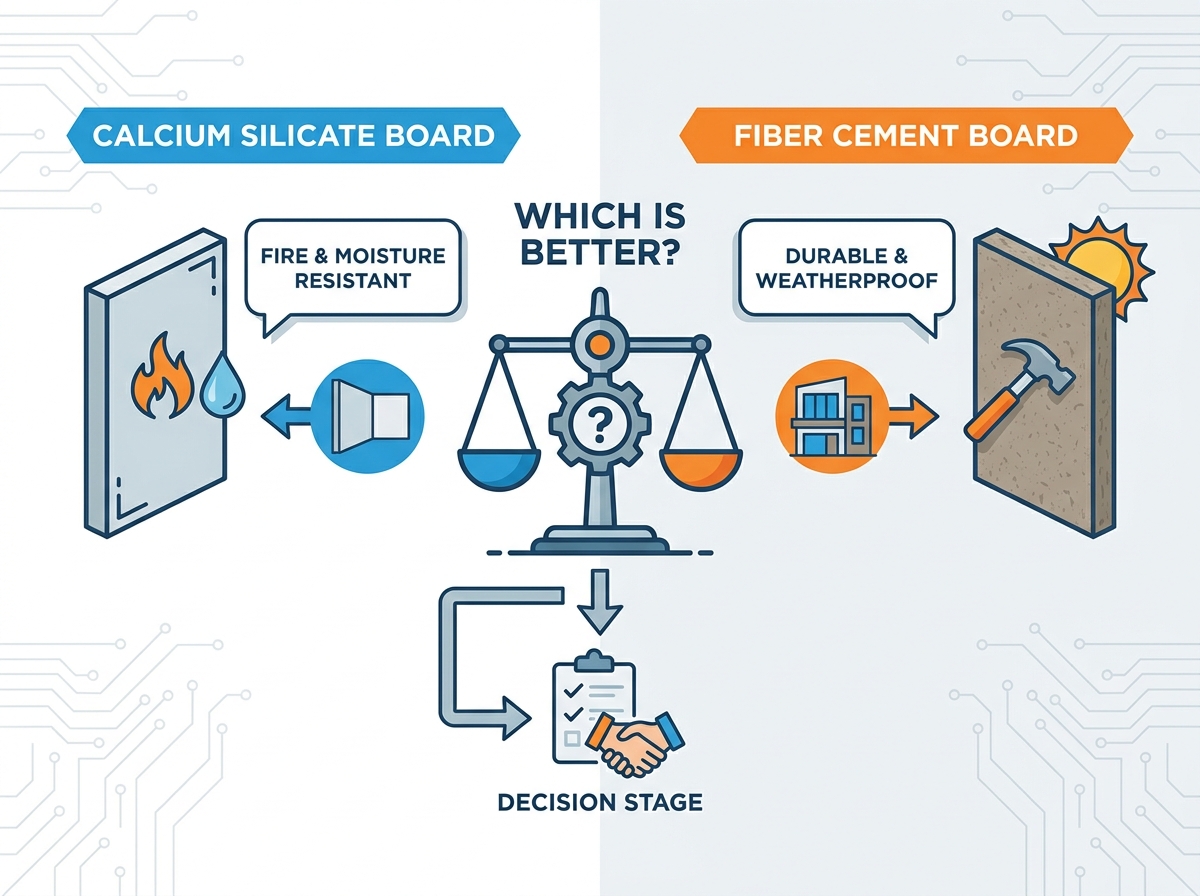
Neither board is universally superior. The decision hinges entirely on the specific demands of the application. Prioritizing impact, weather, and structural load resistance dictates one choice, while prioritizing weight, workability, and extreme-heat thermal insulation dictates the other. To ensure a successful installation, follow these actionable steps:
Review local municipal building codes for specific fire and moisture compliance before finalizing your material schedule.
Request physical material samples for contractor evaluation to ensure tool compatibility and handling feasibility.
Consult a structural engineer to verify load calculations for heavier cementitious boards on elevated floors.
Specify the exact fastener type and joint compound in your architectural drawings to prevent contractor substitutions.
A: Fiber cement board is significantly denser, typically measuring 1.5g/cm³ or higher. Calcium silicate board generally ranges between 0.9g/cm³ and 1.2g/cm³, making it much lighter and easier to handle on site.
A: While possible, it is not recommended without extensive waterproofing and protective coatings. Fiber cement is the industry standard for exterior use due to its superior weather and moisture resistance.
A: Calcium silicate board is lighter, less dense, and easier to cut, often allowing for simple scoring and snapping. Fiber cement requires specialized diamond blades and heavy-duty power tools.
A: They are related in that both provide high-heat insulation. However, calcium silicate is a rigid board used for structural backing, while ceramic fiber is often softer and used for direct extreme-heat lining.
A: Yes. Both materials perform best with manufacturer-specified, corrosion-resistant self-tapping screws. Ribbed-head screws are particularly important for denser boards to allow the screw head to sit flush without cracking the surface.
A: Allow the boards to acclimate to the site's humidity for at least 48 hours before installation. Use alkali-resistant fiberglass mesh tape and elastomeric joint compounds to accommodate minor thermal expansion and building movement.


